
- All
- Product Name
- Product Keyword
- Product Model
- Product Summary
- Product Description
- Multi Field Search
Views: 0 Author: Site Editor Publish Time: 2026-08-07 Origin: Site


The practice of straightening teeth has definitively entered a new era. Today, digital orthodontics integrates 3D data acquisition, computer-aided design (CAD), and automated manufacturing (CAM). These elements completely transform standard clinical workflows. Traditional analog methods simply cannot keep pace. Workflows relying on physical alginate impressions remain deeply flawed. They frequently suffer from dimensional inaccuracies. They generate excessive material waste. They also drain valuable chairside time. Clinics sticking to older methods often struggle to scale efficiently.
This guide objectively evaluates the core components of a modern ecosystem. We will examine the operational returns. We will also explore practical implementation realities. You will learn how to transition smoothly. We will help you mitigate adoption risks. Ultimately, you will discover how to choose the right technological framework for your growing practice.
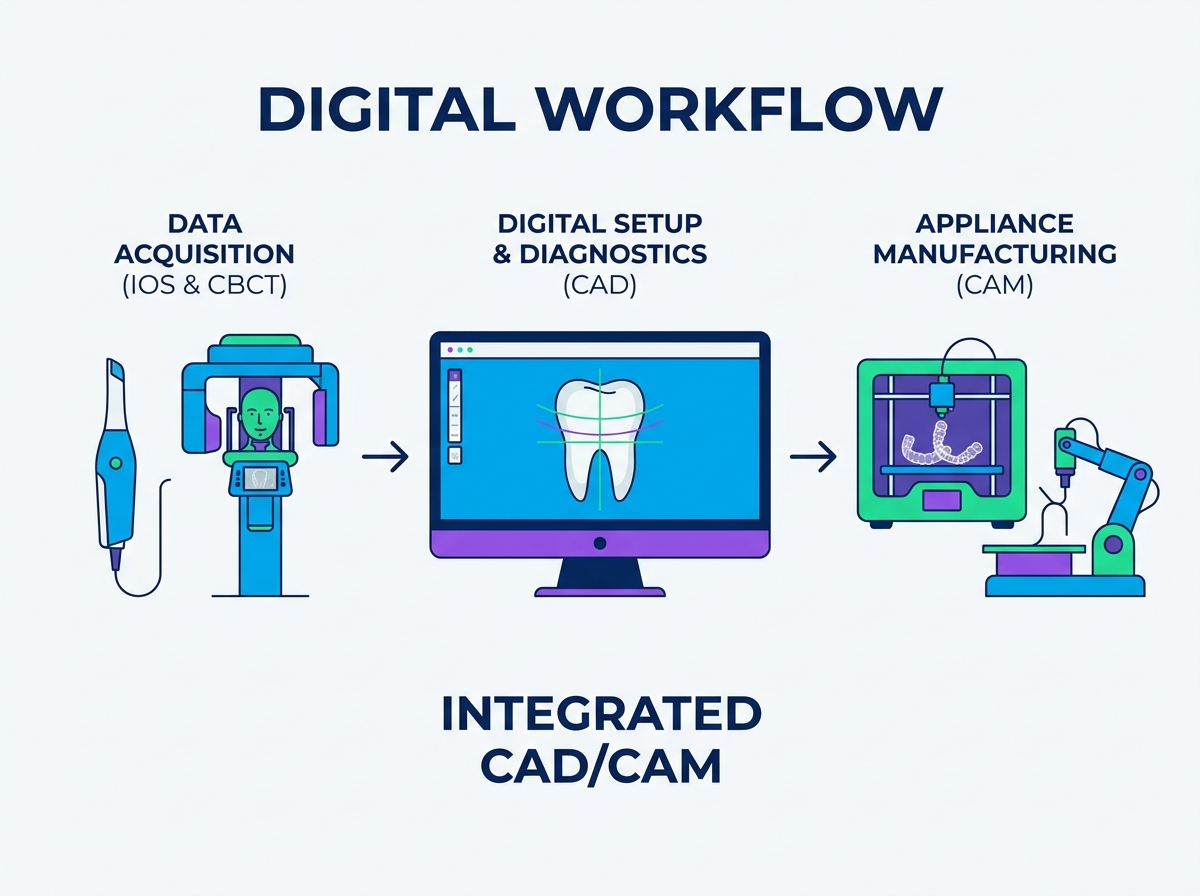
Modern tooth alignment relies on three foundational pillars. You must understand each component to build a successful technological stack. Transitioning away from analog tools demands a comprehensive grasp of these new digital workflows.
Clinics are rapidly abandoning physical impressions. They now prioritize direct digital data capture. Intraoral Scanners (IOS) replace gooey alginate trays completely. Clinicians use these handheld wands to capture exact surface topography. The scanner creates a high-resolution 3D mesh. We call this accurate representation the digital twin.
Simultaneously, Cone Beam Computed Tomography (CBCT) provides deeper clinical insights. CBCT captures underlying bone density. It maps out precise root structures. You cannot see these hidden details using standard surface scanners. Combining IOS and CBCT gives you a truly comprehensive patient model. To ensure high-quality data acquisition, clinical teams should follow specific best practices:
Acquiring accurate data represents only the first step. You must then utilize specialized CAD software. This software merges your IOS and CBCT data effectively. It aligns the detailed surface mesh over the skeletal framework.
This integration unlocks advanced cephalometric analysis capabilities. Algorithms automatically identify key anatomical landmarks. Clinicians can track root positioning safely during active treatment. You plan every complex tooth movement virtually. This virtual staging happens long before any physical appliance touches the patient. Doctors can test multiple treatment scenarios rapidly. They select the safest and most efficient path.
The final component involves translating digital plans into physical reality. We call this computer-aided manufacturing. Clinics often invest heavily in in-house 3D printing. Resin-based printers produce highly accurate physical models.
You can thermoform clear aligners directly over these printed models. You can also print indirect bonding trays. These trays ensure metal or ceramic brackets sit exactly where planned. Some advanced practices even adopt automated wire-bending technology. These robots bend customized archwires based on your specific digital prescription. The standard manufacturing process follows a predictable sequence:
You must look beyond flashy hardware specifications. Evaluating a new ecosystem requires analyzing both clinical results and business returns. The best systems elevate patient care while boosting practice profitability.
Digital workflows drastically reduce physical errors. Impression distortion becomes a thing of the past. Manual pouring errors disappear entirely. You capture exact micro-details of the enamel surface.
This high precision greatly improves tooth movement predictability. AI-assisted staging algorithms calculate optimal force vectors constantly. Biomechanical simulations warn you about potential root collisions. They highlight specific areas requiring interproximal reduction (IPR). Clinicians execute complex treatments safely. They avoid unexpected mid-course corrections.
Upgrading your workflow yields measurable time savings immediately. You will notice significant reductions in initial appointment times. Scanning a full upper and lower arch takes mere minutes. Patients gladly skip the gag-inducing impression materials.
Custom appliances inherently fit better. Better fits mean far fewer emergency visits. Brackets placed via indirect bonding rarely debond. Clear aligners track much closer to the original plan. You open up valuable chair-time for new consultations. Staff members spend less time managing distressed patients.
Adopting new technology changes your clinic's financial model completely. You no longer buy bulk alginate impression materials. You stop paying hefty shipping fees to external dental labs. You eliminate plaster inventory entirely.
Instead, your operational spending shifts. You pay for secure cloud data storage. You cover annual software licensing fees. You buy specialized 3D printing resins. Patient-facing ROI also improves dramatically. Visual treatment simulations engage patients immediately. They see their future smile on a high-definition screen. This visual proof significantly increases case acceptance rates.
| Comparison Metric | Traditional Analog Workflow | Modern Digital Workflow |
|---|---|---|
| Data Capture | Alginate/PVS impressions, highly prone to distortion. | Intraoral scanners, capturing highly precise 3D meshes. |
| Material Costs | High ongoing spending on trays, plaster, and alginate. | Shifts to software licenses and 3D printing resins. |
| Turnaround Time | Takes weeks due to physical lab shipping. | Often same-day or next-day using in-house 3D printing. |
| Patient Experience | Uncomfortable, triggers gag reflexes, messy. | Comfortable, fast, and visually engaging. |
Digitizing patient records introduces entirely new vulnerabilities. You must prioritize daily data security. Clinics cannot afford catastrophic data breaches. Managing digital assets requires strict protocols and robust infrastructure.
Clinics must meet strict compliance regulations globally. United States practices must follow HIPAA rules strictly. European clinics must adhere to GDPR regulations.
Cloud-based digital planning software holds highly sensitive health information. You must sign specific Business Associate Agreements (BAAs) before uploading anything. Outsourcing manufacturing to third-party labs also carries inherent risks. Verify their security certifications constantly. Protect patient identities meticulously. Clinic owners frequently make several common security mistakes:
Managing massive data loads requires a solid technical strategy. Intraoral scans generate incredibly heavy STL and PLY files. CBCT scans produce massive DICOM image sets. A single patient file archive can exceed several hundred megabytes easily.
You must store these files securely over several years. Archiving years of 3D data strains local hard drives quickly. Cloud storage offers much better scalability. It provides automated nightly backups. It protects your clinic against sudden local hardware failures.
Your clinic network needs sufficient processing power. Heavy files easily cause software lag during live consultations. Waiting for a 3D skull to render frustrates prospective patients.
You must assess your clinic internet bandwidth thoroughly. High-speed internet is strictly mandatory for cloud-based solutions. Localized hardware requirements also matter deeply. Consultation computers need robust graphics processing units (GPUs). Strong infrastructure ensures seamless and professional patient presentations.
Every major technological transition carries inherent operational risks. You must prepare your clinical team for these specific challenges. Avoiding these pitfalls guarantees a faster return to profitability.
Do not expect immediate clinical perfection. Your clinic will experience a temporary dip in efficiency initially. Clinicians and auxiliary staff must adapt. They need dedicated time to learn new digital interfaces.
Mastering scanning protocols takes real practice. Keeping the scanning wand steady requires new muscle memory. Saliva control remains critically important during digital data capture. Plan for longer initial appointments during the first month. Your team will gain speed naturally as they practice.
Technology evolves at a blistering pace today. Hardware obsolescence poses a serious financial threat. You risk investing heavily in first-generation scanners. You might buy a 3D printer today. It could easily become outdated tomorrow.
You must balance immediate purchases against equipment leasing models. Buying equipment upfront requires massive capital. Leasing provides far easier upgrade paths. You can swap out aging scanners every few years. Leasing protects clinics from getting stuck holding obsolete technology.
Software costs rarely stop at the initial purchase point. Many clinics fall directly into the subscription trap. Vendors often obscure their ongoing operational costs.
Evaluate every vendor contract carefully. Look closely for hidden administrative fees. Some platforms charge a fee for every single case export. Others require paid subscriptions just for crucial security updates. You might face frustrating tiered feature unlocks. Ensure you understand the long-term subscription expenses completely. Watch out for these hidden costs:
Technology shifts daily responsibilities within your team. You must identify workflow bottlenecks early. Doctors should never spend hours manually cleaning up digital models.
Transferring tasks causes temporary friction. You must train auxiliary technicians properly. Technicians should handle all basic model preparation. They set up initial bracket placements virtually. The orthodontist simply reviews and approves the final plan. Effective delegation maximizes your clinical profitability. It keeps the doctor focused strictly on patient care.
Choosing the right ecosystem dictates your long-term success. Follow a highly structured approach to vendor selection. You must match the technology to your specific operational goals.
Your biggest decision involves selecting a system architecture. You must choose between open and closed digital ecosystems.
Closed ecosystems provide incredibly seamless integration. The hardware and software speak perfectly to each other. However, they enforce strict vendor lock-in. A proprietary scanner might only link to specific aligner brands. You lose negotiating power over time.
Open systems offer maximum operational flexibility. You can export STL or PLY files freely. You can send files securely to any lab globally. You can use any available 3D printer. Open systems do require higher initial technical competency. You must manage the file transfers manually yourself.
Tailor your hardware stack precisely to your specific practice size. A solo practitioner needs a highly streamlined setup. A simple intraoral scanner and a basic printer might suffice perfectly.
Multi-location Dental Support Organizations (DSOs) face completely different challenges. They require highly standardized workflows. DSOs need robust centralized data management. They must monitor case progress across dozens of clinics. Enterprise-level software becomes mandatory for larger groups. They need features like centralized reporting and multi-doctor access controls.
Never buy advanced technology without evaluating the vendor thoroughly. Ecosystem maturity matters greatly. New startups might offer flashy marketing features. Established companies provide reliable daily stability.
Evaluate their technical support Service Level Agreements (SLAs). Equipment downtime costs you significant money. Ask specifically about their continuing education resources. Review their hardware warranty structures thoroughly. You need a responsive business partner, not just an equipment supplier.
Do not schedule vendor demos immediately. Take a calculated next step instead. Conduct a comprehensive 30-day workflow audit locally.
Identify your current analog bottlenecks precisely. Track how much time staff spends pouring models manually. Count the exact number of distorted impressions per month. Calculate your monthly alginate supply costs. Use this hard data to drive your final purchasing decisions. Request targeted vendor demos only after clearly understanding your specific needs. Follow this audit process:
The integration of modern technology fundamentally changes patient care. Implementing digital orthodontics is no longer an experimental differentiator. It now represents a standard clinical baseline. Clinics absolutely need it for achieving clinical precision. They rely on it heavily for operational scalability.
Successful adoption requires clear strategic thinking. You must prioritize open architecture. Comprehensive staff training matters much more than acquiring standalone hardware. A shiny new scanner achieves absolutely nothing without a well-trained operator behind it.
We encourage decision-makers to look ahead constantly. Prioritize strong vendor interoperability. Insist on retaining long-term data ownership during your final contract evaluation. Taking these deliberate steps guarantees a highly profitable technological transition.
A: Most clinics observe a positive return on investment within 18 to 24 months. The exact timeline depends heavily on patient volume. It also relies on your chosen hardware setup. Eliminating physical impression materials provides immediate operational savings. Reducing external lab fees accelerates the financial return dramatically. You must factor in monthly software subscriptions. Initial efficiency dips briefly delay maximum profitability. Thorough staff training helps shorten this payback period significantly.
A: Yes, you can use these files with any compatible printer. You must choose an open architecture system first. Open systems allow you to export standard STL or PLY files. These standard formats communicate seamlessly with almost all modern slicing software. Closed systems restrict this freedom entirely. They often lock your data into proprietary formats. Always verify open file export capabilities before signing any vendor contract.
A: It transforms the patient journey completely. Intraoral scanning eliminates gag-inducing impression materials. Patients appreciate the comfortable data capture process. Virtual simulations boost their confidence immensely. They can visualize their final smile immediately on screen. Custom appliances fit much better. This precision reduces overall physical discomfort. Patients experience fewer unexpected emergency visits. Initial consultation appointments become substantially shorter.
A: Yes, top-tier cloud platforms maintain excellent security standards. Reputable vendors use advanced end-to-end encryption. They comply strictly with HIPAA regulations in the US. They adhere to strict GDPR rules in Europe. You must still implement strong local security protocols. Always require two-factor authentication for staff logins. Never share passwords. Sign a Business Associate Agreement (BAA) with your vendor. Secure data management demands active clinic participation.
A: An open system provides maximum hardware and software flexibility. You can mix and match different brands easily. You export standard files freely to any lab. A closed system restricts interoperability completely. Hardware and software come from a single vendor. Proprietary scanners only work with specific aligner brands. Closed ecosystems offer easier initial setups. Open systems require higher technical skill but ensure long-term freedom.


