
- All
- Product Name
- Product Keyword
- Product Model
- Product Summary
- Product Description
- Multi Field Search
Views: 0 Author: Site Editor Publish Time: 2026-08-07 Origin: Site


The demand for aesthetic orthodontic solutions pushes clinical boundaries every single day. Patients now actively request clear aligner-based arch expansion. They view it as a highly requested alternative to traditional Rapid Maxillary Expansion (RME). For any modern orthodontic lab, manufacturing aligners capable of predictable transverse expansion represents a massive growth lever. However, success in this area is not automatic. It demands strict digital workflows. It also requires a deep understanding of advanced material science. Expanding your facility's capabilities into aligner-based arch expansion takes careful strategic planning. You must evaluate the right 3D staging software to control tooth movements accurately. You need to understand absolute clinical limitations to avoid treatment failures. Finally, you must implement rigorous quality control protocols. These critical steps ensure clinicians get highly predictable results every time. We will explore exactly how you can build these profitable capabilities safely and efficiently.
The dental market shows a definitive shift in patient preferences today. Teens and adults increasingly reject bulky, traditional RMEs. They prefer clear, removable expander systems. This major transition creates a highly lucrative opening. An ambitious orthodontic lab can capture this demand by mastering expansion protocols.
Doing so elevates your entire business model quickly. You transition from being a basic retainer manufacturer to a comprehensive digital treatment partner. Comprehensive partners command premium pricing. They dictate better terms. Doctors gladly pay more for predictable clinical outcomes. They value laboratories capable of solving complex biomechanical challenges. Offering aligner expansion fundamentally changes your value proposition.
Furthermore, the operational margins on expansion cases often exceed those of standard retainers. When an orthodontic lab masters these workflows, they reduce the need for manual wire bending. Digital staging scales much faster than traditional analog lab work. This scalability allows you to increase case volume without proportionally increasing your labor costs. It represents a highly efficient pathway to revenue growth.
Aligner expansion also serves as a powerful competitive differentiator. It acts as a strong barrier-to-entry service. Many basic facilities only handle simple anterior alignment. They lack the specialized expertise needed for complex transverse staging. Labs delivering predictable arch expansion easily win long-term B2B contracts. They separate themselves entirely from low-cost, low-quality competitors. Clinicians always want reliable, knowledgeable partners. You become virtually indispensable when you solve their complex staging problems. You secure loyalty when your products reduce their chair time.
Building trustworthiness requires absolute clinical honesty. You must avoid exaggerated claims regarding aligner capabilities. Clear aligners and traditional RMEs function very differently. Understanding these biomechanical differences prevents costly remakes.
Clear aligners primarily achieve dentoalveolar expansion. They tip crowns and move teeth bodily through the alveolar bone. They do not separate the mid-palatal suture. Traditional RME achieves this true skeletal expansion. This skeletal change occurs primarily in growing patients. You must communicate this biological distinction to your clinical partners clearly. Setting the wrong expectations ruins B2B relationships. If a doctor expects skeletal changes from plastic, they will fail. Your laboratory will take the blame.
Industry consensus highlights clear boundaries for aligner efficacy. Clinical meta-analyses show high predictability for mild to moderate transverse expansion. This predictable range typically falls between 2mm and 4mm. Predictability drops rapidly beyond this specific threshold. You should not promise massive expansion using plastic alone. Transparent case selection prevents tracking failures later. Educating your clients on these limits demonstrates true expertise. It positions your team as trusted advisors, not just order takers.
You can offer alternative product lines for severe cases. Lab-fabricated hybrid approaches bridge this difficult clinical gap. For example, you might design aligners used alongside bone-anchored expanders. This hybrid model provides a powerful solution for complex anatomies. It allows your orthodontic lab to capture revenue even on non-aligner-only cases. Offering hybrid designs shows immense technical flexibility. It proves you understand advanced orthodontics thoroughly.
Clinical Expansion Modalities Comparison
| Feature | Clear Aligners | Traditional RME |
|---|---|---|
| Primary Expansion Type | Dentoalveolar (tipping/bodily movement) | True Skeletal (mid-palatal suture separation) |
| Ideal Target Patient Profile | Adults and older teens | Growing children and early adolescents |
| Highly Predictable Range | 2mm to 4mm | 5mm to 10mm or more |
| General Patient Comfort Level | High (removable, smooth plastic) | Low (bulky, fixed, affects speech) |
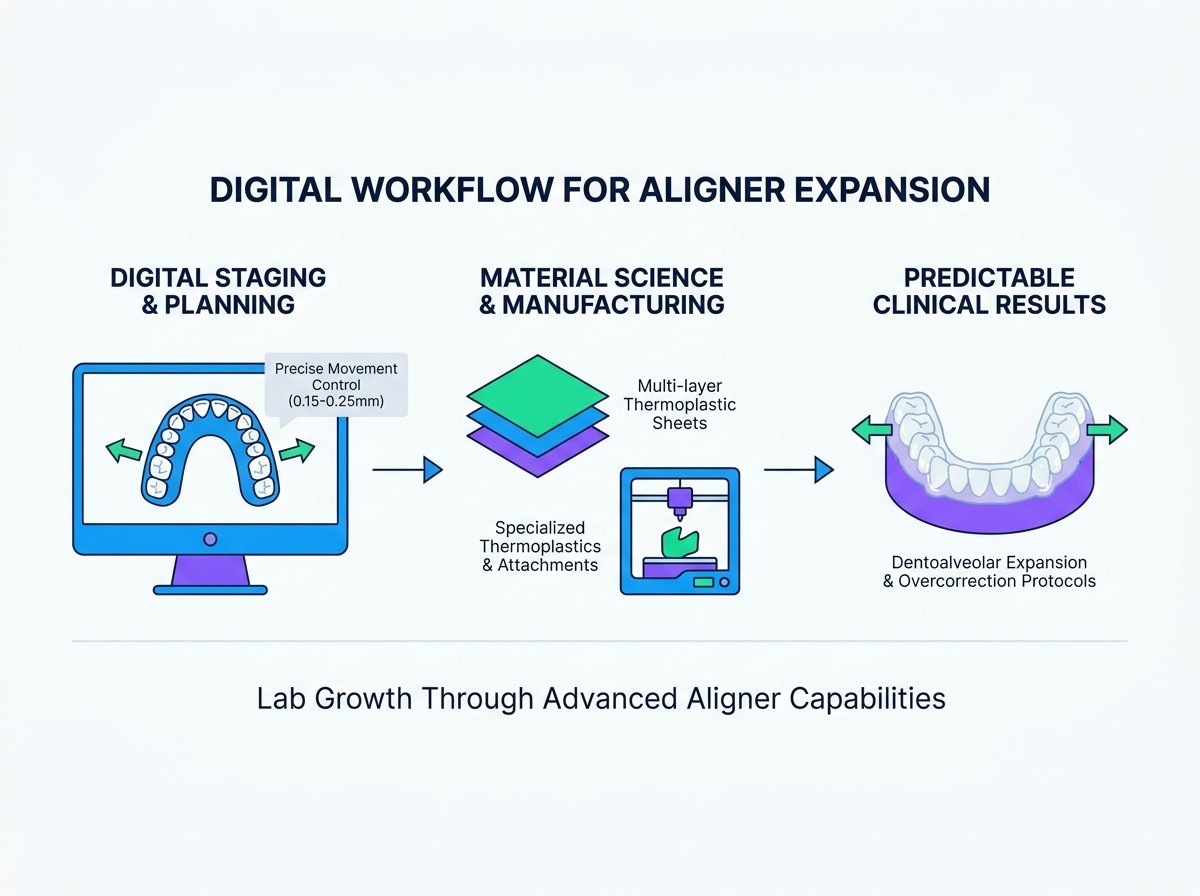
Predictable transverse movements require highly sophisticated tools. You cannot rely on basic software. You cannot use cheap, single-layer plastics. A successful orthodontic lab evaluates its tech stack constantly. Upgrading your infrastructure directly impacts clinical predictability.
Your CAD/CAM orthodontic software must allow granular biomechanical control. Expansion staging demands precise manipulation of root torque. It also requires careful management of crown tipping. Basic software often lacks these crucial micro-adjustments. You need platforms enabling technicians to separate crown movement from root movement visually. If the software auto-calculates without manual overrides, it limits your capabilities. Advanced systems let you customize the center of rotation. This customization prevents the teeth from merely tilting outward.
Consider the learning curve associated with these advanced software platforms. Your technicians will require dedicated training sessions. They must understand the physics of aligner plastics, not just how to click buttons. Investing in ongoing education for your staff pays massive dividends. It reduces digital setup errors dramatically.
Material choice directly dictates your clinical success. Standard PETG materials often fail during expansion cases. They lose their expansive force too quickly in the mouth. Saliva and body heat accelerate this material fatigue. Expansion requires materials delivering sustained, gentle force. You must utilize multi-layer or polyurethane-based thermoplastics. These advanced plastics maintain exceptionally high elasticity. They resist deformation over the entire wear cycle. Multi-layer sheets combine a rigid core with flexible outer layers. This structure pushes teeth effectively while remaining comfortable.
Robust software features automate complex attachment placement. Optimized attachments support expansive forces perfectly. They also prevent aligner dislodgement during treatment. Horizontal beveled attachments on posterior teeth are absolutely critical. They create the necessary undercuts for the plastic to grip. Without these attachments, the aligner simply pops off the molars. Automation speeds up your workflow significantly. It ensures clinical accuracy across multiple technicians.
Staging Software Evaluation Criteria
| Software Feature | Clinical Benefit | Priority Level |
|---|---|---|
| Granular Root Torque Control | Prevents severe buccal tipping | High |
| Automated Attachment Placement | Speeds up design process | Medium |
| Advanced Collision Detection | Prevents overlapping staging | High |
| Virtual Overcorrection Modeling | Compensates for plastic fatigue | Critical |
Rolling out new expansion services introduces distinct risks. You must navigate real clinical hurdles to maintain your reputation. An unprepared orthodontic lab will face high remake rates.
The most frequent failure in aligner expansion involves uncontrolled tipping. Crowns tip buccally while roots remain entirely stationary. This unwanted movement creates severe posterior open bites. It ruins the patient's occlusion. It frustrates both the clinician and the patient immensely. You must design digital setups to prevent this complication entirely. Adding lingual root torque during the expansion phase counters this tipping. Technicians must understand this biomechanical necessity.
The biological reason behind this tipping relates to the center of resistance. The aligner applies force to the crown, far from the root's center of resistance. Without counteracting torque built into the digital plan, the tooth naturally tilts. Your software technicians must act as digital biomechanics experts. They must anticipate this tilt and program the opposite movement proactively.
Safe digital staging parameters maintain crucial biological compliance. You should limit expansion movements strictly to 0.15mm to 0.20mm per stage. Pushing beyond these limits causes the plastic to slip off the teeth. It leads directly to massive aligner tracking failures. Slower, controlled staging guarantees much better tracking. It allows the periodontal ligament time to adapt safely. Rushing the expansion always results in ill-fitting aligners by stage five.
Thermoplastics inherently suffer from rapid energy loss. Incorporating 20% to 30% virtual overcorrection is a necessary Standard Operating Procedure (SOP). Lab technicians must design this extra movement into the final stages. This overcorrection ensures the teeth settle into the actually desired position. If a doctor wants 3mm of expansion, stage for nearly 4mm. The plastic will inevitably fatigue before reaching the final digital position. Overcorrection compensates for this physical reality perfectly.
Rigorous quality assurance prevents expensive, embarrassing remakes. You should implement strict internal QA steps immediately. Do this before exporting any STLs for 3D printing. A dedicated QA manager should review every expansion case.
Here is a reliable QA checklist for your team:
Your sales and support teams need a clear go-to-market plan. They must act as consultative partners to clinicians. Selling expansion services requires education, not just aggressive marketing.
An elite orthodontic lab helps doctors select the right patients. You should help filter out non-viable cases actively. For example, reject severe skeletal crossbites for aligner-only therapy. Guide the doctor toward a hybrid approach instead. Conversely, approve ideal candidates confidently. Look for mild crowding combined with moderately constricted arches. This transparent triage builds immense trust over time. Doctors appreciate a lab that prevents them from starting doomed cases.
Clinical collaboration requires highly efficient communication channels. You must use a secure, HIPAA-compliant digital portal. Clinicians need a safe space to review your expansion staging. They must approve attachments easily through an intuitive interface. They also need to verify overcorrection protocols before manufacturing begins. A smooth, interactive portal experience increases case acceptance rates. It eliminates confusing email chains. It centralizes all clinical notes perfectly.
Lab owners should follow a clear sequence for service adoption. Skipping steps leads to operational chaos.
Mastering aligner-based arch expansion offers a truly potent growth strategy. It transforms any modern orthodontic lab into a premium service provider. However, this growth requires absolute clinical honesty and technical precision. You cannot fake biomechanical expertise.
True success bridges a highly complex gap. You must align digital software capabilities with the biological realities of tooth movement. Software can show anything on a screen. However, plastic and bone have strict physical limits. Acknowledging these limits protects your reputation. It prevents catastrophic clinical failures.
Take decisive action today to secure your market position. Evaluate your current staging software immediately. Audit your thermoplastic suppliers. Determine if they equip you properly for advanced transverse expansion cases. Upgrade your systems now to capture this massive, growing market demand confidently.
A: Not entirely. Aligners are highly effective for dentoalveolar expansion in mild-to-moderate cases. They cannot separate the mid-palatal suture in the way a traditional RME does. This limitation is especially true in non-growing patients. Traditional expanders remain necessary for severe skeletal discrepancies.
A: While clinical limits vary by patient, most literature suggests 2–4mm of overall arch expansion is highly predictable. Staging must be kept strictly to ~0.15mm to 0.25mm per aligner. Appropriate posterior attachments are also strictly required to prevent aligner dislodgement during these movements.
A: Multi-layer elastomeric materials are highly preferred over rigid single-layer plastics. They maintain continuous, gentle force delivery. They also resist the stress relaxation that commonly occurs when expansive forces are applied to the posterior segments. This elasticity improves tracking immensely.


