
- All
- Product Name
- Product Keyword
- Product Model
- Product Summary
- Product Description
- Multi Field Search
Views: 0 Author: Site Editor Publish Time: 2026-07-01 Origin: Site


Private-label orthodontics are experiencing rapid, unprecedented growth worldwide. Dental Service Organizations (DSOs), orthodontic startups, and large dental labs eagerly enter this expanding market. They want to capture higher margins and build lasting brand equity. However, transitioning a conceptual brand into a market-ready product introduces severe bottom-of-funnel challenges. You must select a manufacturing partner balancing clinical efficacy, attractive unit economics, and strict regulatory compliance. A single misstep in this selection phase can derail patient outcomes and ruin your brand reputation before you even launch. This article provides a rigorous evaluation framework for vetting OEM clear aligners manufacturers. We will help you assess critical implementation risks and structure a highly profitable rollout. You will learn exactly how to compare advanced material science, evaluate treatment software integration, and safeguard your operation against dangerous compliance liabilities.
Partnering with an OEM clear aligner manufacturer shifts capital expenditure from facility build-outs to brand scaling and clinician acquisition.
Material science (e.g., multi-layer TPU) and treatment planning software integration are the two biggest differentiators in clinical outcomes and patient compliance.
Regulatory baseline: A viable OEM partner must hold necessary medical device certifications (ISO 13485, FDA 510(k), or CE Mark) to protect your brand from compliance liabilities.
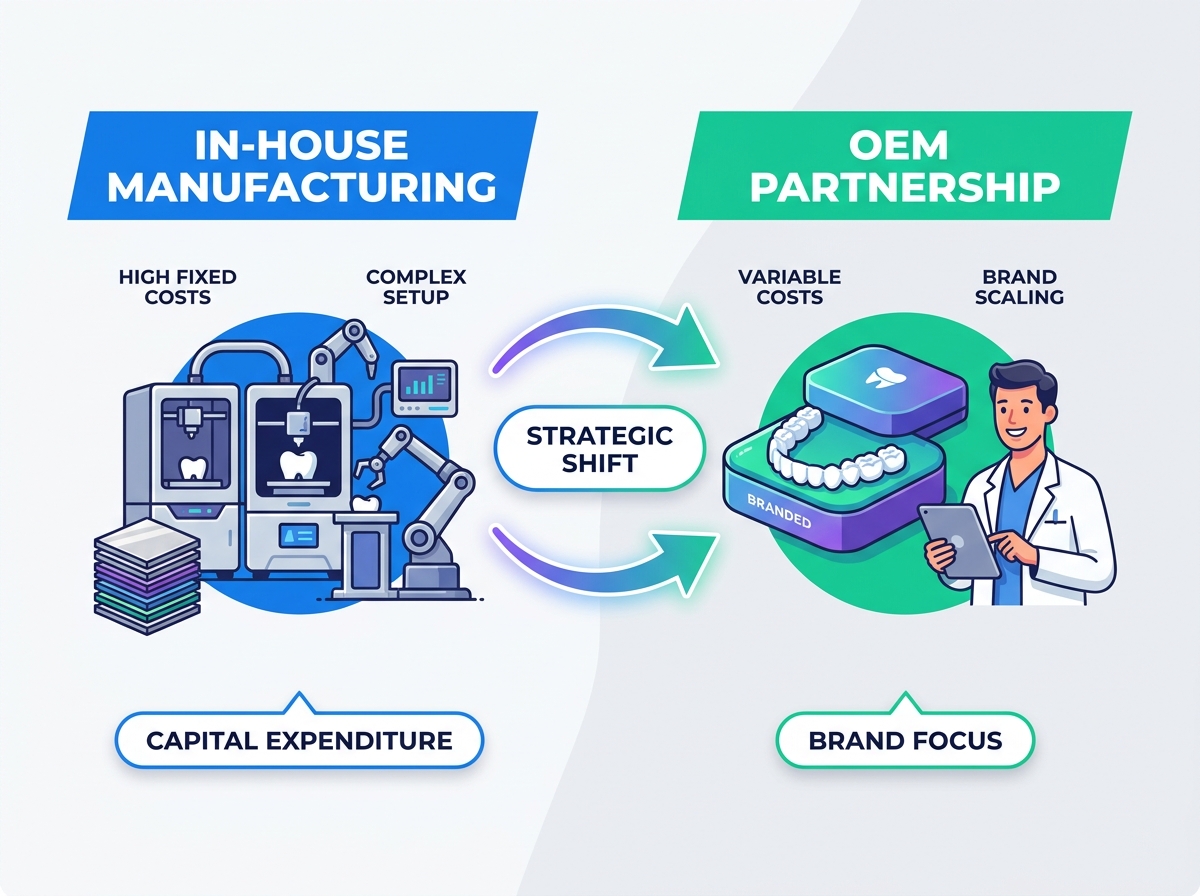
Many dental practices and ambitious DSOs initially consider bringing aligner manufacturing in-house. They want total control over the production pipeline. However, they quickly hit steep barriers to entry. Establishing a fully compliant, high-volume manufacturing facility requires massive upfront capital. You must purchase expensive 3D printing fleets to handle daily mold production. You need sophisticated automated thermoforming machines. Advanced trimming robotics add further immense costs. You also face rigorous, time-consuming FDA registration processes to legally produce medical devices.
Outsourcing solves this exact problem efficiently. By partnering to produce OEM clear aligners, DSOs and startups unlock a highly flexible variable cost structure. You pay only for the exact aligners you sell. You completely avoid heavy fixed overhead and equipment depreciation. This strategic financial shift allows you to redirect crucial funds. You can invest heavily in clinician acquisition, aggressive marketing, and broad brand scaling instead.
What exactly defines a successful manufacturing partnership? We look for three specific success criteria:
Predictable profit margins consistently achieved across all case complexities.
A strict, verified sub-2% manufacturing defect rate to ensure patient safety.
Consistent 7–10 day turnaround times spanning from initial scan to final shipment.
Meeting these core metrics ensures your white-label brand remains competitive, highly profitable, and universally trustworthy.
Material science directly drives clinical efficacy and patient satisfaction. Industry-standard materials generally fall into two distinct categories. Older manufacturing systems typically use single-layer PETG. Modern, premium manufacturers utilize advanced multi-layer TPU, such as Zendura FLX. Single-layer PETG tends to lose its active force rapidly over a few days. It becomes brittle over a typical two-week wear cycle. Multi-layer TPU offers vastly superior stress retention. It applies consistent, highly predictable, and gentle force to move teeth precisely.
Crack resistance also improves drastically with advanced TPU blends. Patients consistently report much higher comfort levels during treatment. Better materials ultimately mean fewer mid-course corrections and fewer frustrated doctors.
The chart below outlines the performance differences between these two primary aligner materials.
Chart: Aligner Material Performance Comparison
Material Type | Force Retention | Crack Resistance | Patient Comfort |
|---|---|---|---|
Single-Layer PETG | Drops significantly after 3 days | Moderate to Low | Rigid, potentially uncomfortable |
Multi-Layer TPU | Maintains consistent force | Very High | Flexible, highly comfortable |
A top-tier manufacturer excels in digital CAD/CAM capabilities. You must evaluate their software ecosystem carefully before committing. Do they offer their own proprietary treatment planning software? Or do they integrate smoothly into open-source, third-party platforms? Proprietary systems often provide much tighter quality control and dedicated support. Third-party platforms, however, offer greater clinic flexibility and easier onboarding for existing staff.
Examine their digital workflow meticulously. The system must handle intraoral scan ingestion seamlessly without file corruption. Automated staging algorithms should significantly reduce manual setup time for technicians. The clinician approval loop needs a highly intuitive web interface. Doctors must review, modify, and approve tooth movement setups quickly. Any friction in this software layer delays patient starts and frustrates clinical teams. Always request a live demonstration of the approval portal to ensure it feels responsive and logically organized.
Manufacturing precision directly affects aligner fit and treatment tracking. Automated trim lines represent a major quality indicator for any partner. Scalloped cuts carefully follow the patient's exact gingival margin. Straight cuts simply leave a straight line of material over the gums. Scalloped edges typically improve patient comfort and look much more discreet. Automated polishing processes remove sharp burrs effectively, preventing oral abrasions.
You must also thoroughly evaluate overall capacity limitations. Can the manufacturer handle sudden, massive volume spikes? Promotional discount periods and Q4 spending pushes often double standard order volumes overnight. Your partner must maintain tight turnaround SLAs during these intense seasonal peaks. A facility running at 90% capacity during normal months will fail during a holiday promotion. Ask explicitly about their maximum daily arch output and machine redundancy protocols.
Quality assurance ensures long-term patient safety. It strongly protects your business legally from disastrous liabilities. A viable manufacturing partner must hold strict medical device certifications. ISO 13485 certification remains an absolute necessity for any serious producer. It dictates rigorous, internationally recognized quality management standards for medical devices. Never compromise on this foundational requirement. If a facility lacks ISO 13485, disqualify them immediately.
Market-specific regulatory clearances matter immensely. Operating legally in the US requires formal FDA 510(k) clearance. European markets demand strict MDR compliance and formal CE Marking. Your manufacturer must expertly navigate these complex regulations. They must successfully extend these critical clearances to legally cover your white-label brand. You cannot simply sell a cleared device under a new name without proper regulatory bridging documentation.
Traceability remains another vital compliance pillar. Ask for detailed, step-by-step batch tracking protocols. You need comprehensive Material Safety Data Sheets (MSDS) for every plastic and resin used. Strict biocompatibility testing prevents dangerous allergic reactions in patients. If a patient experiences an adverse event, you need immediate access to detailed batch logs to identify the exact production run.
Beware of non-compliant offshore manufacturers offering steep discounts. Choosing an uncertified, cheap partner introduces catastrophic business risk. You expose your entire buying brand to mandatory government product recalls. Massive legal liability will fall squarely on your shoulders, not the offshore factory. Proper, rigorous vetting strongly mitigates these dangerous outcomes.
Launching a successful white-label brand takes considerable time and planning. You must accurately map out a standard 60-to-90-day integration timeline. This critical period spans from initial contract signing to your very first patient delivery. Rushing this fragile phase causes cascading operational failures down the line. You need time to train staff, sync software APIs, and test physical samples.
Workflow friction represents the most common point of operational failure. Your clinics likely use various popular intraoral scanners. You might rely heavily on iTero, Trios, or Medit devices. Interoperability between these modern scanners and the manufacturer’s upload portal must be flawless. Test multiple scan uploads rigorously during the trial phase. Broken STL or PLY exports completely halt production and frustrate doctors.
Clinical support handles inevitable treatment deviations gracefully. Treatment revisions happen frequently in daily orthodontics. How exactly does the partner handle complex mid-course corrections? Outline all refinement policies clearly before signing anything. Some premium agreements include unlimited refinement aligners in a single flat fee. Other contracts use a strict pay-per-arch model for every single change. Know your exact financial liabilities for non-tracking cases.
Packaging and fulfillment logistics require careful, early planning. Determine your exact distribution model immediately. In a Direct-to-Consumer (DTC) model, the facility dropships discrete packages directly to patients' homes. A traditional B2B model requires shipping bulk cases directly to your clinical offices. Each specific path demands entirely different packaging durability, insert literature, and branding investments.
Profitable rollouts demand highly transparent financial modeling. You must clearly understand common OEM billing structures to project revenue accurately. Manufacturers generally offer two primary pricing models. The first is a flat-fee comprehensive case model. This structure typically covers all aligners needed for a patient, sometimes including standard refinements. The second is a pay-per-stage or strict pay-per-arch model. Flat fees work exceptionally well for complex, long-term cases where arch counts run high. Pay-per-arch structures suit minor aesthetic adjustments and short relapse treatments perfectly.
Watch out closely for hidden costs in the contract. Easily overlooked expenses erode your profit margins surprisingly quickly. Look specifically for:
Mandatory treatment setup fees charged per digital plan.
Custom branding and bespoke packaging expenses.
Rush shipping fees for emergency cases.
Conduct a highly realistic, conservative margin analysis. Clinics and DSOs must calculate their retail pricing backwards. Start carefully with your guaranteed base manufacturing costs. Add your specific clinical chair time, digital planning time, and facility overhead. Finally, price the treatment to comfortably achieve your target gross margins. A strong OEM clear aligners partner provides absolute predictability in base costs. This financial predictability lets you confidently advertise highly competitive retail prices while securing robust, healthy profits for your organization.
Table: Common Pricing Model Breakdown
Pricing Model | Best Used For | Pros | Cons |
|---|---|---|---|
Flat-Fee Comprehensive | Moderate to severe crowding/spacing | Predictable overall case cost | Higher upfront financial commitment |
Pay-Per-Arch | Minor relapse or aesthetic tweaks | Low initial cost barrier | Costs escalate if treatment drags on |
Choosing the right manufacturing partner gives you a massive strategic advantage. A highly compliant, tech-forward partner elevates your brand reputation immediately. You secure predictable margins and consistently deliver excellent patient outcomes. We highly recommend using a strict shortlisting logic to find the best fit for your business.
Start by auditing the manufacturer's material data sheets.
Request a live demo of their digital software portal.
Verify their regulatory documentation and ISO certifications.
Calculate your exact margins based on their specific pricing models.
Do not leave your brand's success to chance. We encourage you to request physical sample aligners today. Schedule a dedicated capabilities consultation with your top candidates to verify their manufacturing quality firsthand before signing any agreements.
A: Most medical device manufacturers scale with your monthly case volume rather than enforcing strict traditional MOQs. However, if you require custom-branded packaging or bespoke mailers, the facility may require bulk upfront commitments for those specific packaging materials to keep printing costs low.
A: Intellectual property ownership depends entirely on your specific contract. Standard agreements typically state that patient data and clinical records remain yours. However, the proprietary staging designs and digital setup algorithms often remain the intellectual property of the manufacturer's software platform.
A: Standard service level agreements (SLAs) expect total turnaround times of 7 to 13 days. It typically takes 2 to 3 days for initial treatment plan setup and doctor approval. Manufacturing, polishing, and shipping usually take an additional 5 to 10 days.
A: Yes, top-tier partners offer robust API capabilities. They provide standard export and import workflows for intraoral STL or PLY files. This allows seamless integration with popular dental practice management software, significantly reducing manual data entry for your busy clinical staff.


