
- All
- Product Name
- Product Keyword
- Product Model
- Product Summary
- Product Description
- Multi Field Search
Views: 0 Author: Site Editor Publish Time: 2026-07-24 Origin: Site


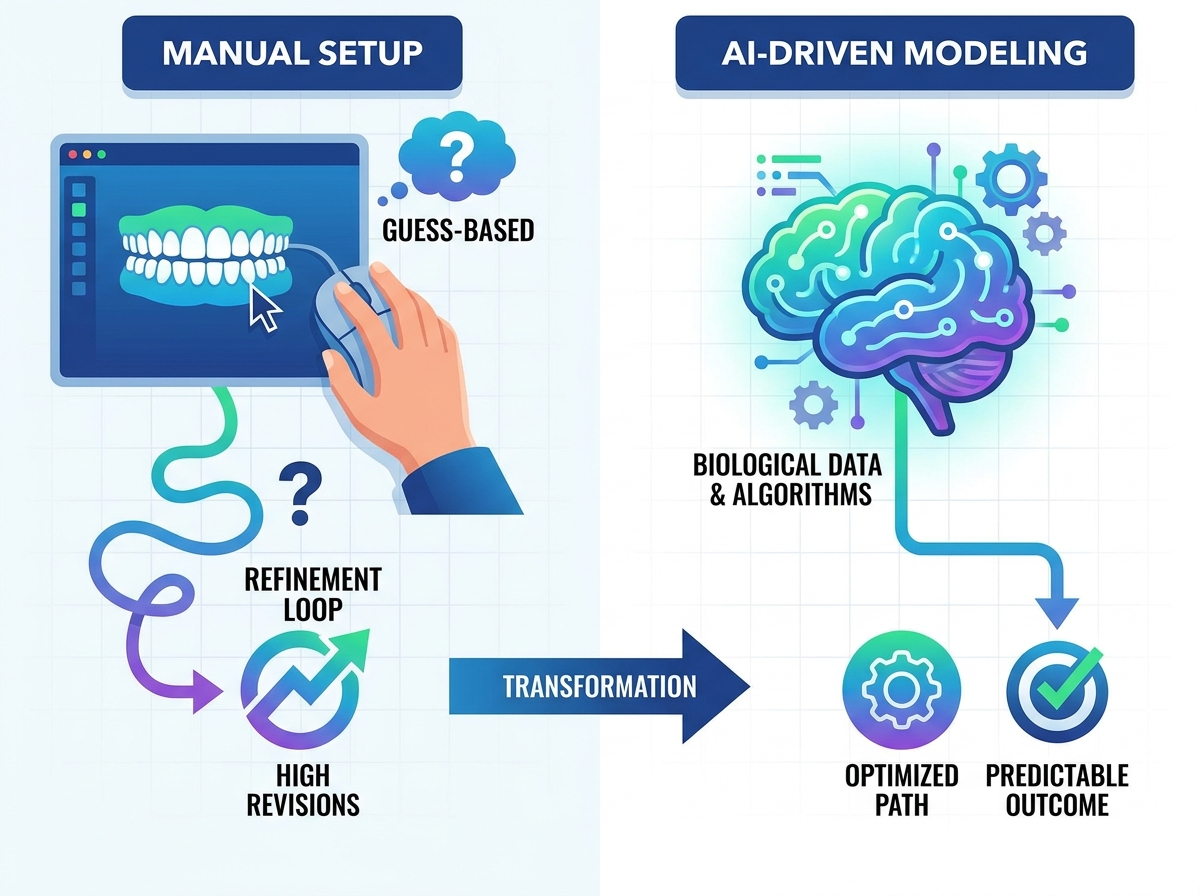
Orthodontics is experiencing a massive shift from manual, guess-based clear aligner setups to predictive, data-driven modeling. Historically, practitioners relied heavily on manual adjustments and technician intuition to plot tooth movements. This approach often led to clinical friction and unpredictable results. While clear aligners have democratized aesthetic orthodontics, unpredictable tooth movements remain a major clinical bottleneck. High refinement rates constantly burden practice workflows and frustrate patients. The underlying issue is relying on basic geometric approximations instead of biological realities.
Modern AI treatment planning software bridges this exact gap between biological reality and digital setups. It empowers practitioners to evaluate, scale, and deliver predictable outcomes. You will discover how biologically aware algorithms calculate root positions and collision risks. We will explore how to evaluate these platforms for clinical safety and compliance. Finally, you will learn practical steps for implementing these systems while maintaining full clinical control. Transitioning your clinic into this digital era will redefine your patient experience entirely.
Traditional workflows carry steep hidden costs for modern dental practices. Doctors spend countless hours manually modifying initial aligner setups on digital screens. You often exchange multiple messages and revisions across different time zones. Human technicians do their absolute best to follow prescriptions. However, they lack access to real-time clinical context. This back-and-forth communication process creates severe chair-time bottlenecks. Doctors often review a setup late at night, send notes, and wait days for an update. High revision and refinement rates ultimately erode practice profitability. You cannot scale a practice effectively under these stressful conditions.
A successful transition to intelligent automation looks very specific. Practice owners should look for fewer initial software modifications before approving a case. We also need improved predictability for complex tooth movements. Extrusions and rotations are notorious for tracking failures during clear aligner therapy. Better predictability naturally leads to increased case acceptance from hesitant patients. Patients appreciate shorter, more accurate treatment timelines devoid of endless refinements.
The industry is currently experiencing a necessary paradigm shift. We are moving away from purely geometric software architectures. Old systems simply moved teeth on a digital screen for aesthetic appeal. They completely ignored the surrounding bone and tissue constraints. Today, biologically aware algorithms calculate actual root position and bone density. They actively analyze collision risks before treatment ever begins. This prevents unforeseen complications mid-treatment and protects the patient's periodontal health.
Machine learning radically speeds up the initial case drafting phase. It automatically isolates teeth and gingiva from intraoral scans instantly. This automated segmentation reduces turnaround time from days to mere minutes. You no longer wait weeks to present a viable plan to your patient. Fast segmentation allows treatment coordinators to close cases on the same day.
Predictive biomechanics transforms how we evaluate potential clinical outcomes. The software predicts root collisions actively throughout the staging process. It suggests optimal attachment placements based on historical success rates. You can see precisely which movements push biological limits safely. AI treatment planning models cross-reference millions of past cases. They understand exactly how much force specific teeth require to move predictably. This features-to-outcomes mapping changes the entire clinical approach.
Security and compliance remain mandatory checkpoints for evaluating any vendor. Practices must verify SOC 2, HIPAA, and GDPR compliance independently. Anonymized patient data handling ensures ethical machine learning practices globally. You must protect sensitive health records at all costs to avoid liability.
Evidence-oriented evaluation separates reliable clinical tools from marketing hype. Look for platforms backed strictly by peer-reviewed literature. NIH or PubMed validated studies provide genuine assurance of algorithmic accuracy. Avoid proprietary, unverified data sets published solely by the software vendor. True clinical validation requires independent scientific scrutiny and long-term retrospective studies.
| Feature Category | Legacy Geometric Software | Modern Biologically Aware AI |
|---|---|---|
| Segmentation Process | Manual tracing by offshore technicians | Automated machine learning extraction |
| Biomechanical Limits | Visual approximations on a 2D/3D screen | Predictive collision and root analysis |
| Turnaround Time | Days to weeks | Minutes to hours |
| Scientific Validation | Internal marketing claims | Peer-reviewed literature (NIH/PubMed) |
We must distinguish between clinical-grade B2B software and B2C mail-order aligner algorithms. These two solution categories serve entirely different purposes in dentistry. Professionally supervised tools assist clinicians directly inside the practice. Direct-to-consumer algorithms often attempt to bypass professional oversight entirely. Mail-order companies focus on rapid cosmetic alignment over long-term functional stability.
Dentists see critical missing variables in at-home clear aligner kits. Remote platforms operate blindly regarding foundational oral health. They lack vital CBCT integration and comprehensive bone level analysis. TMJ considerations are routinely ignored during remote treatment staging. You simply cannot diagnose active periodontal disease from a smartphone selfie. Ignoring a patient's periodontal phenotype can lead to disastrous recession.
Trustworthiness requires acknowledging balanced claims about automation. Algorithms speed up the drafting phase incredibly well for straightforward cases. However, safe treatment requires a licensed provider evaluating the entire patient. Doctors must override algorithmic blind spots constantly to prevent harm. Active periodontal disease requires immediate human intervention and physical treatment. Severe skeletal discrepancies cannot rely on software alone for correction.
Consider these clinical realities when comparing professional tools against direct-to-consumer models:
Assessing compatibility remains a top priority during software procurement. Your chosen platform must integrate smoothly across existing daily workflows. Check its compatibility across existing hardware setups meticulously. This includes popular intraoral scanners like iTero, Trios, and Medit. You should also ensure it speaks cleanly to your practice management software. Open platforms help you avoid frustrating vendor lock-in over the long term.
Staff and doctors will inevitably experience a learning curve. Standardizing new clinical protocols takes considerable time and patience. You will see a temporary productivity dip during the initial rollout phase. This is completely normal during major digital transitions in any medical clinic. Team members must learn new interfaces and communication tools thoroughly.
Workflow adjustments require strategic training for all clinical personnel. Associate doctors and treatment coordinators must adapt their case presentation styles. They should learn to trust the proposed setups initially as a baseline. However, they must always verify the biological feasibility before ordering aligners. Blind trust in automation creates unacceptable clinical liabilities for the practice owner. Calibration meetings help align the entire clinical team on new protocols.
Follow these exact steps to mitigate adoption risks effectively:
Practice owners must measure the financial impact carefully before committing. Calculating return on investment involves tracking the exact time saved per setup. You must also measure the reduction in mid-course corrections accurately. Fewer refinements mean fewer unnecessary chair-time hours wasted on scanning. This boosts your profit margin per case significantly over the fiscal year. Time is the most valuable asset inside any busy orthodontic practice.
A rigid vendor evaluation framework prevents costly operational mistakes. You should ask specific technical questions during every software demo. Does the platform offer open-architecture exports like STL or OBJ files? This capability is critical for in-house 3D printing and manufacturing control. Evaluate the pricing model closely based on your current case volume. Decide if per-case fees or monthly subscriptions fit your budget better. Inquire heavily about the frequency of algorithm updates. Stagnant software falls behind modern clinical standards rapidly.
We highly recommend requesting a sandbox demo using past clinical cases. Upload a challenging case you successfully finished last year. See how the software handles the exact same malocclusion. Did it suggest the same interproximal reduction strategy? Did it place attachments in similar locations for root control? You can compare the newly proposed setup against the actual historical outcome. This proves the accuracy of AI treatment planning definitively. You will see firsthand if the algorithms suggest more efficient paths.
| Evaluation Metric | Optimal Software Feature | Clinical Benefit |
|---|---|---|
| Export Architecture | Open STL/OBJ downloads | Enables immediate in-house printing without restriction |
| Update Frequency | Quarterly machine learning pushes | Ensures practice access to the latest predictive limits |
| Pricing Structure | Tiered subscription or per-case | Scales predictably alongside clinic volume growth |
The transition toward intelligent automation represents a permanent evolution in orthodontics. Practices utilizing advanced algorithms report profound efficiency gains across all clinical departments. This technology is rapidly transitioning from a high-tech novelty to a baseline standard of care. Software remains only as effective as the educated clinician wielding it. Advanced modeling provides an incredibly accurate roadmap for predictable tooth movement. The practitioner must ultimately drive the biological execution and monitor patient compliance.
To maximize this digital transition, implement the following actions:
A: No. AI automates digital staging and suggests biomechanically optimal paths, but a licensed doctor must diagnose, approve, and monitor the biological response. The technology functions strictly as an advanced decision-support system rather than a clinical replacement. Clinicians always remain in the driver's seat.
A: Current clinical studies indicate AI setups require significantly fewer modifications than human technicians. They eliminate repetitive back-and-forth revisions. Algorithms predict realistic collision risks much faster. However, complex skeletal cases still require manual clinician overrides to ensure safe, predictable tooth movements.
A: Legitimate, enterprise-grade platforms use end-to-end encryption. They comply with HIPAA and GDPR guidelines strictly. Vendors strip all identifiable information before feeding data into their training models. You should always verify a vendor's specific compliance certifications before uploading any intraoral scans.
A: Most modern platforms are "open system" and accept standard STL or PLY files from major scanners. Practices should still confirm direct API integrations. Native integration prevents the need for clunky manual file transfers. This ensures a much smoother daily operational workflow.


