
- All
- Product Name
- Product Keyword
- Product Model
- Product Summary
- Product Description
- Multi Field Search
Views: 0 Author: Site Editor Publish Time: 2026-07-28 Origin: Site


Transitioning from traditional orthodontics to clear aligners requires a fundamental shift in clinical mindset. You must pivot away from reactive wire adjustments and embrace a proactive, digital-first strategy. High refinement rates, prolonged chair time, and unpredictable tooth movements constantly frustrate practitioners today. These clinical bottlenecks rarely happen because of poor patient compliance. Instead, they usually stem from flawed initial digital staging and unrealistic force applications. If you master the digital setup phase, you can drastically reduce mid-course corrections. This guide breaks down the essential mechanics of clear aligner treatment planning. It thoroughly compares distinct operational models, specifically weighing in-house software against outsourced design services. We also provide an evidence-based framework for evaluating digital planning platforms and reliable service partners. You will discover actionable steps to optimize your clinical workflows and improve patient outcomes immediately.
Modern orthodontics relies heavily on accurate digital setups. We define clinical treatment planning as the precise conversion of intraoral scans (IOS) and Cone Beam Computed Tomography (CBCT) data into a sequential, biomechanically sound digital staging sequence. This process transforms raw anatomical data into a step-by-step roadmap for tooth movement. It requires understanding biological boundaries just as much as digital geometry.
A predictable digital setup depends on several key technical components. If you ignore these elements, you risk severe tracking failures and root damage.
Practices face a distinct business problem today. Software algorithms frequently output numerous physical possibilities. However, digital possibilities do not always equal biological realities. An algorithm might show overlapping roots seamlessly bypassing each other. Accurate planning requires you to apply strict clinical constraints to these algorithms. You must bridge the gap between digital estimations and actual biology to ensure predictable outcomes.
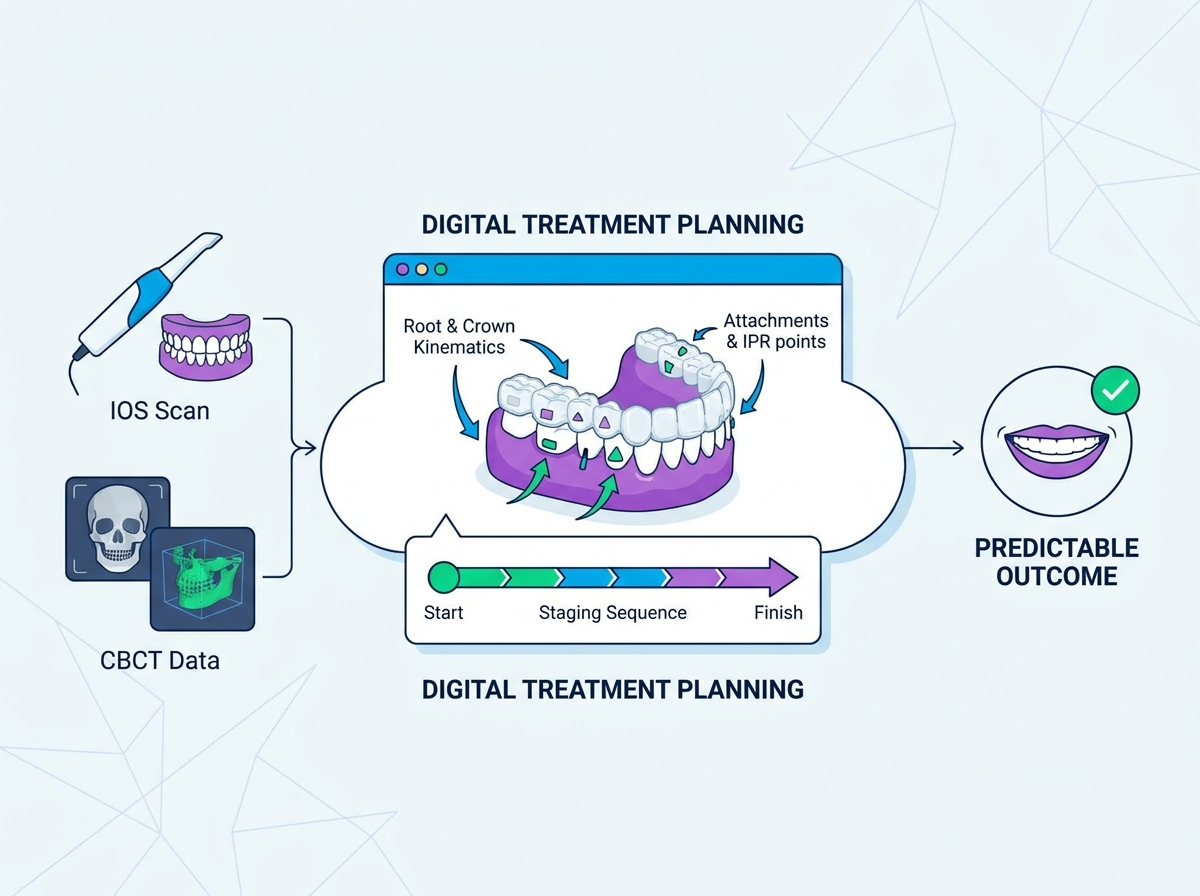
Dental practices must choose how they manage their digital setups. You generally select between two primary operational models. Both approaches offer unique advantages for scaling your aligner therapy.
This approach involves utilizing open-system platforms. You typically use specialized CAD software designed for digital orthodontics. The clinician or an in-house lab technician manually maps out the tooth movements stage by stage.
Managing the process internally gives you maximum clinical control. You dictate every single attachment, velocity rate, and IPR measurement. This method also results in a much lower per-case cost when you operate at scale. However, it carries a steep learning curve. Mastering biomechanical staging software demands significant dedication. You also have to allocate extensive staff time to design every individual case.
Many practices prefer partnering with specialized digital orthodontic labs. You might also use white-label design services provided by clear aligner brands. You upload your patient records, and the service provides an initial digital setup. The physician then reviews, modifies, and approves this setup.
Outsourcing acts as a highly scalable solution. It instantly frees up doctor chair time. You can review a proposed setup in five minutes rather than spending an hour building it. The trade-off involves introducing recurring per-case fees. You also risk potential communication lag. Explaining specific revisions to an outsourced technician sometimes requires multiple back-and-forth messages.
Decision Matrix: In-House vs. Outsourced Models
| Factor | In-House Software | Outsourced Services |
|---|---|---|
| Clinical Control | Maximum control over every staging detail | High control, but relies on tech interpretation |
| Time Investment | High (requires dedicated design time) | Low (only requires final review and approval) |
| Scalability | Limited by in-house staff bandwidth | Highly scalable regardless of case volume |
| Learning Curve | Steep (requires software mastery) | Minimal (focuses only on clinical review) |
Your case volume heavily dictates the right category. Available staff expertise and your existing clinical workflow also play crucial roles. High-volume clinics with dedicated lab technicians often thrive with in-house software. Smaller practices usually benefit more from outsourcing to specialized labs.
Selecting the right digital platform requires rigorous evaluation. You cannot rely on marketing claims alone. Assess potential solutions across four critical dimensions to protect your clinical standards.
Software features must directly translate to biological outcomes. Does the platform utilize realistic collision detection? It must identify when roots intersect. Ensure the system respects actual biological limits. Some basic software allows impossible movements, like expanding molars through cortical bone. You need a platform that actively flags biologically unachievable tooth trajectories.
A good solution seamlessly ingests standard digital formats. Check how easily the platform handles STL and PLY files. It must integrate directly with your existing intraoral scanners. If you manufacture in-house, the software must export print-ready files smoothly. Friction in data transfer wastes valuable staff hours and delays patient care.
Patient data protection remains non-negotiable. Digital setups involve transmitting sensitive health records, facial photos, and medical histories. Verify that cloud-based platforms maintain strict HIPAA and GDPR compliance. If you use outsourced teams, ensure they hold relevant ISO certifications. Security breaches damage patient trust irreparably.
You rarely approve a setup on the first try. Evaluate the turnaround time for modifications. Measure the communication friction involved in altering a digital setup. Does the platform offer an intuitive 3D web viewer? Can you easily leave pinpointed clinical notes? Fast, accurate revisions keep your manufacturing schedule on track.
Adopting digital workflows introduces new operational challenges. Practitioners often underestimate the friction of integrating new technology. Understanding these realities helps you mitigate risks before they impact patient care.
Dental technology heavily promotes artificial intelligence. You should view these claims with healthy skepticism. AI auto-setups provide excellent starting points, but they are never finished products. Algorithms lack clinical intuition. They cannot palpate bone thickness or assess periodontal health. Human clinical oversight remains absolutely mandatory. You must review every AI proposal to prevent unachievable plastic forces from damaging patient dentition.
Implementing new software inevitably causes short-term operational drag. Your team will initially slow down as they learn new interfaces. You must establish standard operating procedures immediately.
Follow these steps for successful clinical onboarding:
Software perfection cannot overcome physical hardware flaws. The most brilliant digital staging fails if your initial impression lacks detail. Scanner calibration directly impacts the accuracy of the STL file. Furthermore, final manufacturing quality matters immensely. If your 3D printer lacks high resolution, the thermoformed aligner will not fit the staging model. Material properties of the plastic also dictate force delivery. You must align excellent software with premium physical manufacturing.
Selecting a partner dictates your clinical success for years. You must approach this decision methodically. Vet potential vendors using a structured, evidence-based process.
Look beyond the software interface. Investigate the clinical foundation of the platform. Seek vendors backed by strong clinical advisory boards. Prioritize companies that publish peer-reviewed evidence validating their algorithm's staging accuracy. A vendor should confidently explain their biomechanical principles. If they cannot articulate their rules for root torquing or IPR staging, look elsewhere.
Never commit to a platform blindly. You should always recommend testing a vendor with specific trial cases. Select three to five moderate-complexity cases. Avoid overly simple cases, as they do not test the platform's limits. Avoid highly complex surgical cases initially. Use these moderate cases to evaluate communication speed. Assess the intuitiveness of their user interface. Most importantly, verify the setup accuracy before you push for full clinic adoption.
You must take immediate action to improve your practice. Start by auditing your current refinement rates. Identify exactly where your current cases fail to track. Next, request software demos from top-tier treatment planning providers. Finally, map out your current digital workflow to identify operational bottlenecks. Clear visualization of your existing processes highlights exactly where you need new technology.
Effective clear aligner digital setups bridge the crucial gap between software capabilities and biological realities. Algorithms provide immense speed, but they still require your clinical expertise to yield safe results. We must respect the anatomical boundaries of the patient above all else.
Whether you bring software in-house or outsource to specialized digital labs, your ultimate goal remains unchanged. You need predictable clinical outcomes. Predictability directly protects your practice profitability and reinforces profound patient trust. Embracing digital mechanics transforms a stressful refinement cycle into a smooth, rewarding patient journey.
Consider these final actionable steps to refine your workflow:
A: A treatment setup refers strictly to the digital 3D model representing the teeth in various positions. Planning is the strategic clinical logic applied to reach that physical setup safely. The setup shows the destination, while the planning dictates the biomechanical speed, attachments, and sequence needed to get there.
A: Biologically accurate initial planning drastically reduces the need for mid-course corrections. When you properly calculate staging velocity and respect root boundaries, teeth track accurately with the plastic. Preventing unrealistic force applications early eliminates the primary cause of aligner lag and subsequent refinements.
A: It depends on the software architecture. Open-architecture platforms easily accept universal STL or PLY files from virtually any modern intraoral scanner. Closed-architecture systems restrict you to specific scanner brands. You should always prioritize open systems to maintain hardware flexibility in your practice.
A: CBCT data revolutionizes modern digital setups by revealing true root morphology and surrounding bone density. Integrating this data prevents clinicians from accidentally pushing roots through the cortical plate. It allows for safer, highly predictable movements because you analyze the entire tooth, not just the visible clinical crown.


