
- All
- Product Name
- Product Keyword
- Product Model
- Product Summary
- Product Description
- Multi Field Search
Views: 0 Author: Site Editor Publish Time: 2026-07-01 Origin: Site


Scaling a dental practice or lab's clear aligner volume often hits a strict bottleneck. You quickly face the harsh limitations of in-house production or the unpredictable inconsistencies of your current lab partner. Overcoming this hurdle requires a strategic operational shift. Selecting a third-party partner is an incredibly high-stakes decision. This choice directly impacts patient outcomes, tight profit margins, and your hard-earned clinical reputation. You cannot afford missteps in material quality or delivery timelines.
This guide provides a rigorous, evidence-based framework for evaluating a clear aligner manufacturer. We move past flashy marketing claims to deeply assess compliance, advanced material science, and operational service level agreements. You will learn exactly how to secure a reliable production partner. You will gain actionable steps to protect your practice from hidden fees and delayed shipping schedules.
Transitioning from in-house to a dedicated clear aligner manufacturer mitigates capital expenditure risks and unlocks immediate scalability.
Regulatory compliance (FDA/CE/ISO) and the use of premium, trackable thermoplastics are non-negotiable baselines for evaluation.
A successful pilot program requires testing a manufacturer with 2-3 straightforward cases to stress-test their digital setup turnaround and communication channels.
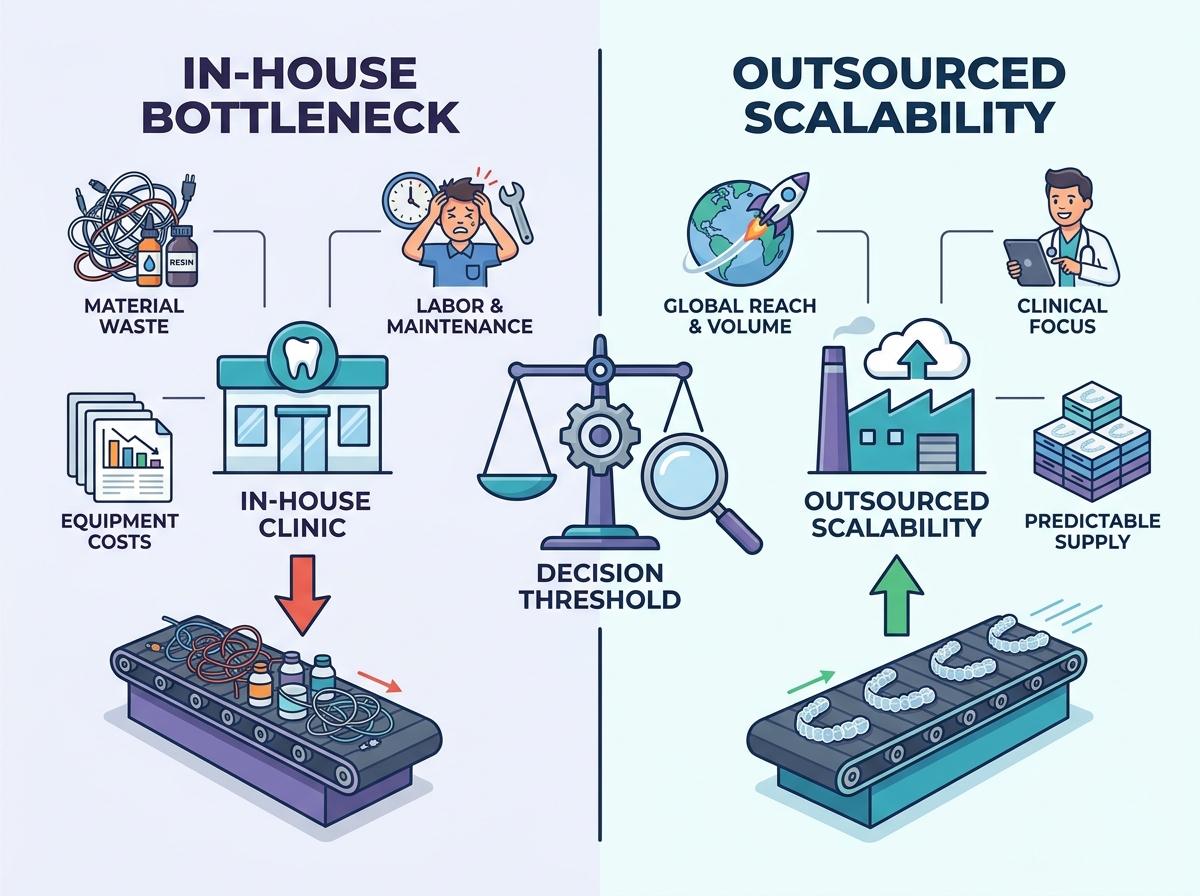
Many clinics start printing aligners internally. In-house printing looks highly appealing initially. However, hidden expenses add up rapidly. Resin management becomes messy and hazardous. Hardware depreciates quickly over just a few years. Labor costs rise as technicians spend hours on manual tasks. Post-processing errors frequently ruin entire production batches. Contrast these daily frustrations against outsourced predictability. A specialized lab absorbs these operational headaches completely.
You must define the exact volume threshold for switching. Partnering with a specialized clear aligner manufacturer becomes financially optimal at a specific point. Usually, surpassing 20 to 30 cases monthly signals this breaking point. At this volume, equipment maintenance consumes too much clinical time. Outsourcing unlocks instant scalability for regional dental labs and busy clinics alike. It frees up your working capital for better investments.
Outsourcing fundamentally changes your daily operations. Clinicians can finally redirect their focus properly. You stop worrying about manufacturing logistics, resin inventory, and printer calibrations. Instead, you concentrate purely on patient acquisition. You can dedicate more energy to precise treatment management. This strategic shift drives higher revenue and improves overall patient satisfaction.
Never assume a lab follows proper safety regulations. You must demand exact certifications upfront. Look specifically for FDA 510(k) clearance in the US. Check carefully for CE marking if operating in Europe. Require ISO 13485 certification for strict medical quality management. You must verify these claims actively. Search official regulatory databases rather than simply accepting a smooth sales pitch. Compliance protects your clinical license and your patients.
Material properties define clinical success. You must evaluate the exact thermoplastics used. Never accept generic, unnamed plastics for your patients.
Standard PETG materials lose orthodontic force rapidly. They stretch out after just a few days of wear. They also crack easily under heavy bruxism. Multi-layer polyurethane (PU) blends perform significantly better. They deliver sustained, gentle orthodontic force over two weeks. PU blends also resist fracturing under immense biting pressure. We highly recommend asking your lab about their specific polymer blends.
Material Feature | Standard PETG | Multi-Layer Polyurethane (PU) |
|---|---|---|
Force Retention | Drops significantly after 48 hours | Maintains consistent force for 14 days |
Crack Resistance | Low (Prone to fracturing under stress) | High (Flexible and highly durable) |
Patient Comfort | Rigid and potentially abrasive | Adaptable and comfortable fit |
Stain Resistance | Moderate | Excellent |
How a lab trims the plastic matters immensely. Automated laser trimming seals the plastic edges smoothly. This advanced process protects delicate gingival margins beautifully. Manual trimming often leaves sharp micro-abrasions behind. Automated processes ensure supreme patient comfort from day one. They also guarantee perfectly consistent margins across hundreds of individual trays. Always ask a prospective lab about their specific trimming hardware.
Digital friction ruins clinical efficiency. Assess portal integration very carefully before signing contracts. Does their portal accept files effortlessly? It must integrate flawlessly with open-system intraoral scanners. Leading devices include iTero, TRIOS, and Medit. Seamless STL or PLY file uploads save hours of administrative frustration. Rigid portals cause daily headaches for your office staff.
Time kills case acceptance rates. Define acceptable industry benchmarks for delivery. Initial digital setups should return to you fast. A turnaround time (TAT) of 48 to 72 hours represents the industry standard. Anything slower risks losing patient interest completely. Fast setups keep your treatment pipelines moving smoothly.
You must understand who exactly plans the cases. Differentiate between basic technician-led setups and orthodontist-reviewed plans. A top-tier clear aligner manufacturer adapts directly to you. They follow your specific staging preferences closely. They must listen if you prefer early IPR scheduling. They must adapt if you prefer delayed attachment placement. Customization indicates true clinical expertise.
Frame your core evaluation around strict delivery guarantees. Digital setups represent only half the battle. You need guaranteed physical delivery times for the actual aligners. A robust Service Level Agreement (SLA) protects your scheduling integrity. It ensures patients never arrive for appointments empty-handed. Ask exactly what happens when the lab misses a confirmed deadline.
DSOs and growth-focused clinics need strong branding. Evaluate how the lab handles custom packaging closely. They should offer brand-specific boxes for your clinic. Custom labeling instantly elevates your clinic's perceived authority. Direct-to-clinic fulfillment simplifies your internal inventory management. Some premium labs even offer direct-to-patient shipping for simple refinements.
Pricing transparency remains absolutely critical for long-term partnerships. You must map out all exact costs beforehand.
Audit every single pricing tier very carefully. Look out for stealthy revision fees. Check for unexpected mid-course correction charges. Ask about standard versus expedited shipping fees. These hidden fees erode your profit margins quickly. Reputable partners publish their full fee schedules openly.
Setup Fees: Is the digital plan billed separately from manufacturing?
Revision Fees: Do you pay extra for tweaking a setup before approval?
Shipping Costs: Are standard deliveries bundled, or billed per box?
Retainer Costs: Are final retainers included in the comprehensive package?
Non-tracking cases happen occasionally. A fair, generous remake policy is essential. Define what constitutes a commercially viable warranty upfront. Will they cover a mid-course correction entirely? Do they require proof of patient compliance first? Clarify these exact terms before signing an agreement. A five-year unlimited refinement window offers the best clinical peace of mind.
Avoid bad partnerships by spotting obvious warning signs early. Vague material sourcing represents a massive red flag. Beware of labs utilizing unnamed, generic plastics. Some manufacturers white-label low-tier materials aggressively. They actively refuse to disclose the chemical composition. Always demand recognized, premium brands like Zendura or Taglus. Material secrecy usually hides severe cost-cutting measures.
You need direct access to your design team. Opaque communication channels signal future frustrations. Can you speak directly to the CAD technician? Can you consult the orthodontist handling your complex digital setup? If they hide behind generic ticketing systems, walk away immediately. Excellent clinical outcomes require seamless, two-way communication daily.
Beware of proprietary software lock-ins. Rigid ecosystems trap your clinical data intentionally. You must be able to export STL files easily at any time. A platform preventing you from switching labs later represents a massive business risk. True open platforms earn your loyalty through quality, not forced software restrictions.
Test heavily before you fully commit. Follow a strict methodology to test a new clear aligner manufacturer. A controlled pilot program mitigates your clinical risk entirely. It exposes operational flaws before you transition your entire caseload.
Start your pilot very simply. Do not send complex, multi-disciplinary cases initially. Send two to three mild-to-moderate crowding cases instead. Simple Class I malocclusions work best for this test. This strategy isolates and evaluates their baseline setup accuracy perfectly. It prevents major clinical disasters during the initial testing phase.
Measure the results objectively once the physical aligners arrive. Do not rely on mere impressions. Use a standardized audit framework to grade the lab.
Audit Category | Specific Metric to Evaluate | Expected Standard |
|---|---|---|
Packaging & Presentation | Box integrity, labeling accuracy, cleanliness | Zero damage, premium feel, correct patient ID |
Clinical Fit | Intimate adaptation to tooth morphology | No rocking, crisp gingival margins, tight seal |
Attachment Templates | Ease of seating and material retention | Easy insertion, accurate well shapes, no flash |
Patient Feedback | Initial comfort and edge smoothness | No tongue lacerations, minimal speech impact |
Choosing a reliable lab partner is fundamentally about risk management. It requires strict operational alignment, not just finding the absolute lowest price per stage. You must look beyond initial cost savings. Evaluate their material integrity, software flexibility, and shipping predictability thoroughly. A strong partnership elevates your clinical reputation and drives sustainable practice growth.
Take immediate action today. Audit your current aligner expenses closely. Request detailed material specification sheets from two prospective labs. Initiate a small trial case this week. Testing the waters directly is the only true way to measure a lab's actual capabilities.
A: Most reputable labs process the initial digital setup within 2 to 3 days. Once you approve the setup, physical manufacturing and quality control typically take 5 to 10 days. Shipping adds another 2 to 3 days depending on your location. Always confirm these exact SLA timelines before signing any contract.
A: Yes, modern labs operate on open-system architectures. They accept standard STL and PLY files from almost all leading intraoral scanners. Devices like iTero, TRIOS, Medit, and Carestream easily export to these universal formats. You rarely need proprietary hardware to initiate a successful partnership.
A: Data ownership depends entirely on your specific B2B agreement. In open ecosystems, you generally own the clinical data and can export your STL files freely. However, proprietary labs may restrict portal access or refuse file exports if you terminate the contract. Always clarify intellectual property rights upfront.


