
- All
- Product Name
- Product Keyword
- Product Model
- Product Summary
- Product Description
- Multi Field Search
Views: 0 Author: Site Editor Publish Time: 2026-07-01 Origin: Site


The rapid expansion of the clear aligner market has flooded the dental industry. You now see countless white-label manufacturers everywhere. Dental labs pop up constantly offering cheap orthodontic solutions. This massive surge makes procurement feel highly commoditized today. Choosing a partner based strictly on the lowest cost-per-arch rarely succeeds in the long run. It often leads to unmanageable revision rates later. You also face significantly increased chair time. Patients lose trust quickly when their treatment stalls.
To protect clinical outcomes and practice margins, dental professionals must evaluate potential partners closely. You must apply a strict lens of material science. You must demand superior software interoperability. Real operational scalability matters immensely. In this guide, you will learn exactly how to identify the ideal manufacturing partner. We explore polymer quality deeply. We review open-architecture platforms and essential regulatory compliance. You will also discover a practical step-by-step framework. This allows you to confidently audit your next clear aligner supplier.
Material matters most: Long-term clinical success relies on the supplier’s use of advanced polymers (e.g., multi-layer TPU) over rigid, outdated plastics (e.g., standard PETG).
Software dictates efficiency: Open-architecture treatment planning software significantly reduces revision bottlenecks compared to proprietary, locked-in ecosystems.
Hidden costs erode margins: True supplier cost must be calculated by factoring in revision fees, shipping logistics, and mandatory clinical support tiers.
Compliance is non-negotiable: Verifiable regulatory compliance (FDA/CE/ISO) protects the practice from liability and ensures consistent batch quality.
Chair time remains your most valuable clinical asset. Poorly fitting aligners consume it incredibly fast. Every minute spent adjusting a bad tray represents lost revenue. When trays fail to track properly, you must schedule extra appointments. Constant adjustments drain your clinical schedule daily. Unplanned refinement scans frustrate both you and the patient. You lose money every single time a patient occupies a chair for an unscheduled fix. A reliable clear aligner supplier prevents this exact scenario. They deliver precise fits right out of the box. They ensure attachments engage the plastic perfectly. This keeps your daily schedule running smoothly. You can see more patients and generate higher daily revenue.
Predictable delivery deeply impacts patient satisfaction. Service Level Agreements (SLAs) matter tremendously here. If a lab promises a two-week delivery, they must honor it consistently. Patients grow impatient rapidly when treatments stall. Delayed shipments hurt your local reputation. On the flip side, smooth processes build immense trust. Happy patients leave glowing five-star online reviews. They gladly refer friends and family members. Your supplier's reliability directly drives your word-of-mouth growth. A dependable supply chain acts as an invisible marketing tool.
You generally have two main financial models in this space. You can choose to resell a major name-brand aligner. This model offers high patient recognition instantly. However, it yields a notably lower profit margin per case. Alternatively, you can utilize a white-label clear aligner supplier. This model delivers a much higher margin. It does require practice-led marketing efforts. You must build your own brand authority locally. Choosing the white-label route allows greater pricing flexibility. You can offer competitive rates to cash-paying patients. You just need a partner capable of producing top-tier clinical quality.
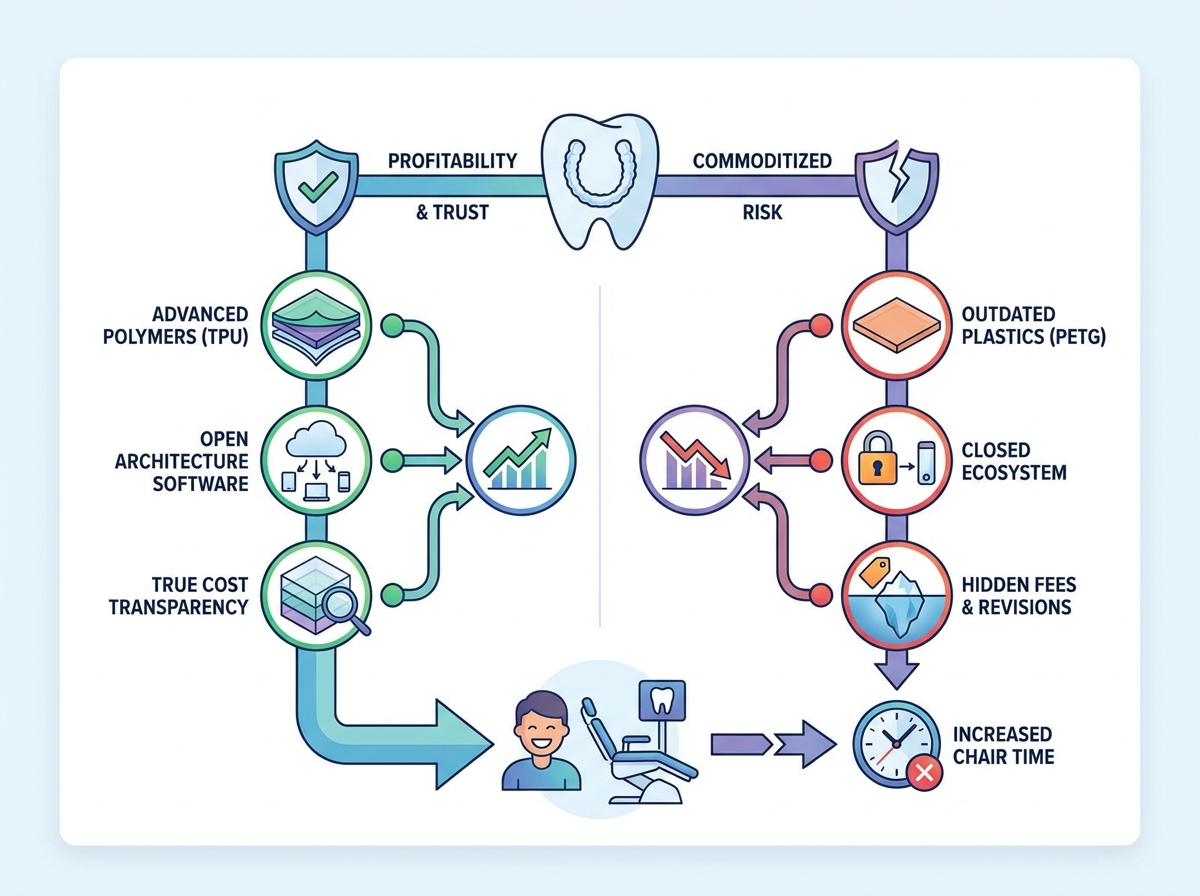
Material science separates acceptable results from true clinical excellence. Older materials primarily rely on single-layer PETG plastics. PETG loses orthodontic force rapidly after just a few days of wear. It feels rigid and frequently cracks under heavy occlusal stress. Modern manufacturers use advanced multi-layer polyurethane (TPU) blends. TPU offers sustained orthodontic force over a full week or two. The dual-shell structure provides a soft inner layer for ultimate comfort. The tough outer shell resists cracking and prevents coffee staining. Always ask your lab about their specific polymer sourcing. Do not accept generic plastic descriptions.
Excellent material requires equally excellent manufacturing precision. Thermoforming must be flawless to capture intricate attachments securely. Automated trim lines represent a highly critical quality indicator. Some labs still use straight cuts across the gingiva. This straight cut feels bulky. It compromises retention and irritates the gums. Scalloped trim lines follow the gingival margin perfectly. They improve patient comfort immensely right away. They also provide much better biomechanical control during complex tooth movements. When evaluating a lab, request physical samples. Inspect these automated cuts under a dental loupe.
Patient safety demands strict regulatory oversight always. You absolutely cannot risk partnering with uncertified backyard labs. A trustworthy partner holds verifiable, clear credentials. Look for FDA 510(k) clearance in the United States. Ensure they hold CE marking for European markets if applicable. ISO 13485 certification proves they maintain rigorous medical device quality management systems. These certifications protect your practice from serious liability. They guarantee consistent batch quality across hundreds of cases. You sleep better knowing your lab operates legally and safely.
Material Type | Force Retention | Patient Comfort | Durability & Wear |
|---|---|---|---|
Standard PETG | Drops rapidly after 2-3 days | Rigid, bulky sensation | Prone to cracking under stress |
Multi-Layer TPU | Sustained force over 7-14 days | Flexible, snug adaptation | High crack and stain resistance |
Software compatibility dictates your daily workflow efficiency directly. Some popular brands force you into closed ecosystems entirely. They require proprietary intraoral scanners to submit cases. This locks you out of competitive pricing options across the market. An open-architecture lab accepts standard STL or PLY files gladly. You can use your existing Trios, iTero, or Medit scanners effortlessly. Open platforms reduce friction across your entire clinic. They allow your dental assistants to upload cases rapidly. You avoid unnecessary, expensive hardware investments. Your clinic remains agile and technologically independent.
AI-generated setups look impressive initially on screen. However, relying entirely on algorithms poses major clinical risks. Algorithms often ignore biological limits like safe bone envelopes. A reputable partner ensures licensed orthodontists review every single setup. These specialists adjust staging to reflect real-world predictability. They sequence complex movements safely over time. You must retain the ability to communicate directly with these professionals. Your software portal should allow easy 3D modifications. You need full control before you approve the final case.
Treatment modifications carry hidden financial risks. You must scrutinize revision policies closely before signing agreements. Some labs charge per individual refinement arch. This model penalizes complex cases severely. It creates a stressful financial dynamic midway through treatment. Better partners offer comprehensive revision tiers instead. Look for "unlimited" refinement packages spanning three to five full years. This transparency allows you to quote patients confidently upfront. It completely removes the fear of surprise lab bills later.
Realistic processing times keep your clinical schedule intact. Turnaround Time (TAT) guarantees vary wildly across different vendors. Domestic labs might promise quick 7-14 day deliveries. International labs often take 3-4 weeks minimum. You must factor shipping logistics into the true turnaround metric. Customs delays can derail international shipments unpredictably at times. Ask potential partners for their verified on-time delivery metrics. Consistently fast turnarounds allow you to start treatments quickly. You capture the patient's excitement while motivation remains incredibly high.
Growing practices need highly scalable financial terms. Minimum Order Quantities (MOQs) dictate how many cases you submit monthly. High MOQs punish smaller clinics unfairly. Flexible partners offer sensible volume tiering structures. As your submission volume grows, your per-case rate should drop accordingly. Volume-based discounts improve your practice margins significantly over time. Discuss these pricing tiers early during the initial negotiation phase. Ensure the vendor scales gracefully alongside your own clinical growth.
Generic help-desk support fails completely in clinical dentistry. You need fast, specialized answers for clinical issues. If a tray misaligns, a generic chatbot cannot help you at all. A premium vendor assigns a dedicated account manager to your practice. They also provide direct access to peer-to-peer clinical troubleshooting. Speaking with another dental professional solves complex tracking issues rapidly. Robust clinical support transforms a basic manufacturer into an indispensable practice partner.
Here are the core support elements a premium clear aligner supplier should provide:
A dedicated account manager for billing and logistics resolution.
Direct portal messaging access to staging orthodontists.
SLA-backed response times guaranteed under 24 hours.
Comprehensive access to clinical troubleshooting webinars or specific guides.
Never commit blindly to a new laboratory. Request material safety data sheets (MSDS) first. Ask for physical sample sets sent directly to your office. Test the aligner clarity under harsh clinical lights. Flex the tray forcefully to gauge its brittleness. Inspect the trim quality along the scalloped gingival margins carefully. Real-world physical testing reveals truths slick marketing brochures hide.
Software usability matters every single day. Submit a complex, retrospective case for evaluation. Choose a challenging case you have already completed successfully. Evaluate the vendor's software interface thoroughly. Compare their staging logic against your own known clinical outcome. Did they catch the difficult premolar rotation? Did they stage the anterior extrusions safely? This trial exposes their true clinical competence beautifully.
Do not migrate your entire volume instantly. Start very small. Select three to five low-complexity anterior alignment cases. Use these specific cases to stress-test the vendor completely. Monitor their communication speed during the setup phase. Track their shipping reliability closely. Most importantly, evaluate the actual clinical fit during patient delivery. If the pilot succeeds flawlessly, you can safely scale your partnership.
Selecting a clear aligner supplier represents a vital strategic business decision. This choice bridges your clinical efficacy with crucial operational economics. The right partner elevates your clinical outcomes drastically. They also protect your bottom line securely over the long term.
Prioritize suppliers offering complete transparency. Demand clear information regarding their polymer material sourcing. Look for highly transparent, predictable revision pricing models. Insist on open-software architecture to maintain maximum flexibility. Avoid locked hardware ecosystems entirely.
Take decisive action today to secure better profit margins. Download our vendor scorecard to track these vital metrics. Alternatively, request a material sample kit immediately. Begin evaluating your current or future lab partners using this rigorous framework.
A: A traditional dental lab handles custom, one-off restorations like crowns or single retainers. They rely heavily on manual labor. A clear aligner manufacturer operates a highly automated, at-scale facility. They leverage industrial 3D printing and robotic thermoforming. This allows them to produce hundreds of aligners daily with extreme precision and consistency.
A: Yes, most reputable suppliers provide robust treatment planning solutions. They typically offer proprietary or partnered web-based portals. These cloud platforms allow doctors to review 3D setups easily. You can modify staging and approve cases directly online. You rarely need to purchase expensive third-party planning software.
A: Absolutely. Efficacy depends entirely on two major factors. First, the supplier's material choices matter immensely. Second, the practitioner's treatment plan dictates the actual tooth movement. The brand name printed on the box does not move teeth. High-quality white-label products using multi-layer TPU perform identically to major brands.
A: You should look for transparent, predictable pricing models. Common industry models include pay-per-arch, limited refinements, and comprehensive unlimited plans. Unlimited 3-to-5-year plans offer the best safety net for complex cases. They eliminate hidden refinement fees completely. This allows you to price patient treatments predictably from day one.


