
- All
- Product Name
- Product Keyword
- Product Model
- Product Summary
- Product Description
- Multi Field Search
Views: 0 Author: Site Editor Publish Time: 2026-05-14 Origin: Site


Have you ever wondered how clear aligners are marked so precisely? The answer lies in the Laser Marking System for Clear Aligners. This technology ensures accuracy, speed, and durability in the production process.
In this article, we will explore how laser marking machines work, the key components involved, and the benefits they bring to aligner manufacturers. You'll learn how this system revolutionizes production and improves traceability, efficiency, and cost-effectiveness.
A Laser Marking System for Clear Aligners is a specialized piece of equipment used to mark and engrave serial numbers, logos, and other custom identifiers onto clear aligners. This system uses fiber laser technology to produce highly detailed, durable, and permanent marks without relying on consumables like ink. The laser works by focusing a beam on the surface of the aligner, removing material to create a lasting mark. This system is integrated with software that controls the marking process, ensuring consistency and high-quality results in every batch.
The beauty of this system lies in its automation. Once set up, it operates with minimal manual intervention, marking each aligner quickly and accurately. A typical laser marking process takes as little as 3.5 seconds to complete four marks on an aligner.
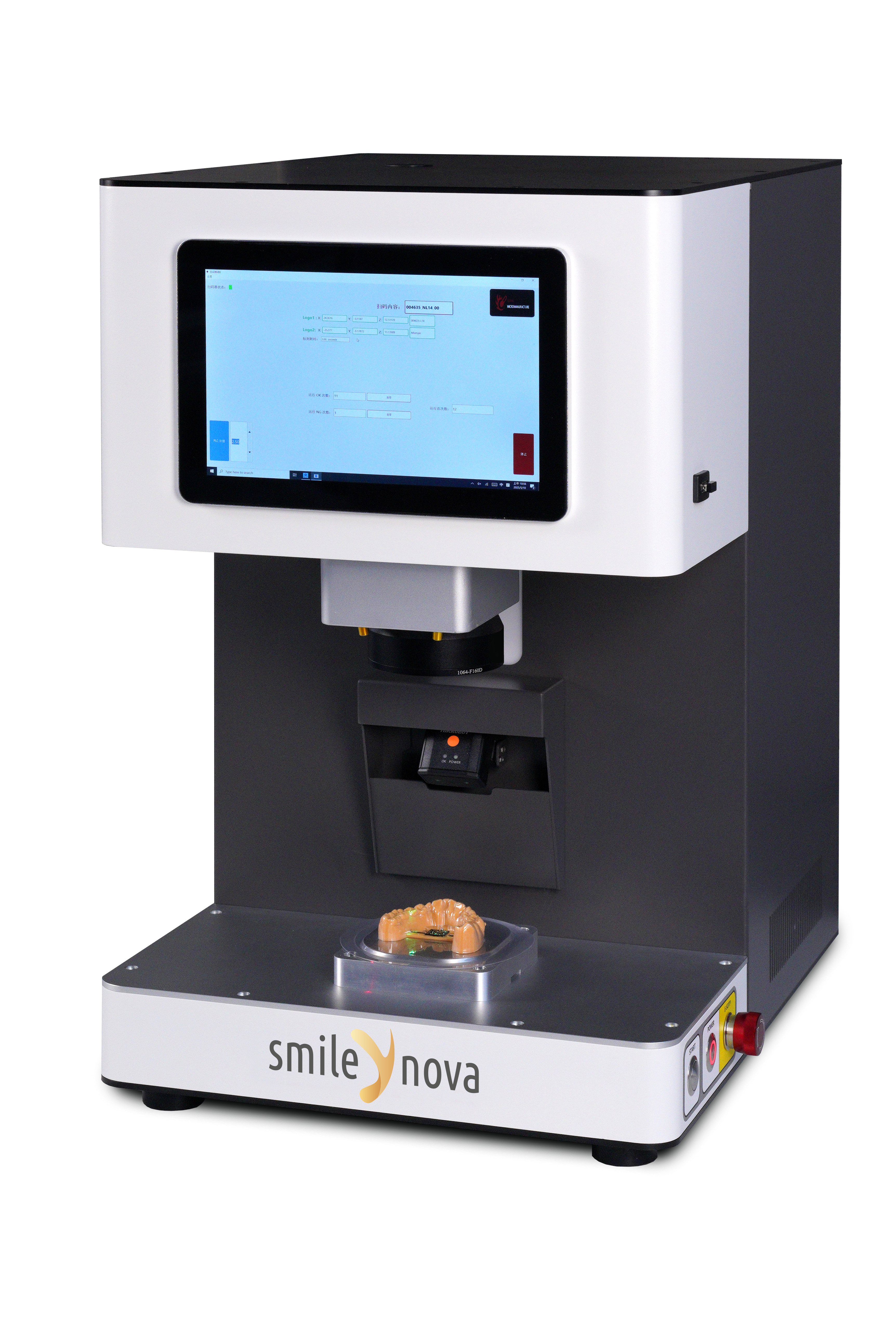
Laser marking is ideal for clear aligners for several reasons. First, the precision offered by lasers ensures that the markings are clear and easy to read, which is crucial for traceability and compliance in the orthodontic industry. Secondly, laser marking is incredibly fast, allowing manufacturers to mark large volumes of aligners in a short amount of time. This speed is essential in meeting the increasing demand for aligners in a competitive market.
Additionally, laser marking eliminates the need for consumables like ink or labels, making it a more cost-effective and environmentally friendly option. It also reduces the risk of smudging or fading marks, ensuring that each aligner has a permanent, legible identifier.
Tip: If your production line is scaling up, a Laser Marking System for Clear Aligners can help streamline the process, saving time and reducing costs in the long run.
Component | Description | Specifications |
Fiber Laser | Main tool for engraving permanent marks | 30W power, 1060nm wavelength |
High-Speed Scanning Galvanometer | Ensures accurate laser beam positioning | Marking speed: ≤70,000 mm/s, Accuracy: ±0.002mm |
Z-Axis Control System | Adjusts focus for optimal engraving | Stepper motor: TST42-48P, Pulley: XL15/82XL-10mm |
Industrial Computer | Controls the laser system and marking process | Touchscreen All-in-One PC |
Automatic Marking Software | Software that coordinates engraving content and coordinates | Windows-based, handles text and graphic marking |
The core of a Laser Marking System for Clear Aligners is the fiber laser. These lasers are preferred because of their efficiency and ability to produce high-quality, high-contrast markings. A typical fiber laser used for clear aligner marking has the following characteristics:
● Power: 30W
● Wavelength: 1060nm
● Laser Type: Pulsed
● Operational Lifespan: ≥100,000 hours
● Cooling: Air-cooled
● Power Supply: 220V 50Hz AC
The fiber laser is highly durable and requires little maintenance. The pulsed nature of the laser allows for precise and fine engravings on the plastic or composite material used in clear aligners.
A scanning galvanometer is a crucial component of the laser marking system. This system is responsible for moving the laser beam across the aligner, controlling the marking position with high precision. The galvanometer can achieve speeds of up to 70,000 mm/s, ensuring fast marking without sacrificing accuracy.
The Z-axis control system is responsible for adjusting the laser's focus, ensuring that the beam is perfectly aligned with the surface of the aligner. This focus adjustment is essential for achieving clear, precise marks that are both readable and durable.
An industrial computer with touchscreen software drives the Laser Marking System for Clear Aligners. This software is specifically designed for marking orthodontic products, allowing users to input custom text and graphics to be engraved. The system automatically extracts the required marking information, adjusts the beam’s position, and executes the marking process.
The software is designed for ease of use, with intuitive controls that allow for easy configuration and troubleshooting. This automation ensures consistency across each aligner, eliminating human error.
Marking Process | Speed | Accuracy | Time per Mark |
Initial Setup | N/A | N/A | N/A |
Laser Alignment | N/A | ±0.002mm | N/A |
Engraving | ≤70,000 mm/s | ±0.002mm | 3.5 seconds per 4 marks |
Quality Control | N/A | Ensures clear, readable markings | N/A |
The process starts with setting up the aligners in the system. Aligners are placed onto the system’s tray or conveyor, which positions each piece correctly for the laser to mark. Before the actual marking begins, the system’s calibration is checked, ensuring that the laser is properly focused on the aligner surface.
Calibration also involves configuring the software to input custom marking details, such as serial numbers or logos. The system automatically adjusts for each aligner’s unique dimensions, ensuring a perfect fit for every mark.
Once the system is calibrated, the laser marking process begins. The fiber laser is directed to the aligner using the scanning galvanometer and Z-axis control system, marking the aligner with precision. The system engraves the custom content (e.g., serial numbers or logos) in a few seconds, with minimal risk of error.
The laser beam removes material from the aligner’s surface, leaving behind permanent, high-contrast markings that are both readable and durable.
Tip: A Laser Marking System for Clear Aligners can mark up to four points in 3.5 seconds, drastically reducing the time required to prepare products for shipment.
Once the marking process is complete, the system performs a final quality control check. This ensures that all marks are placed accurately and meet the required standards. If any adjustments are needed, the software can make real-time corrections to guarantee the highest quality.
Laser marking offers unmatched precision, ensuring that every mark is clean, clear, and legible. This is crucial for traceability, as orthodontic products need to be easily identifiable for patient safety and compliance. Laser marks are also permanent, reducing the risk of fading over time.
Laser marking is a fast and efficient process. With the ability to mark up to four points on an aligner in 3.5 seconds, manufacturers can increase output and reduce production time. Additionally, laser systems do not require consumables like ink or labels, resulting in lower long-term costs.
The lack of consumables in laser marking makes it an environmentally friendly option. Without the need for ink, labels, or other materials, the system reduces waste and minimizes the environmental footprint of the manufacturing process.
If the markings are misaligned or unclear, it’s often due to improper calibration or focus. Ensure that the Z-axis control system is correctly aligned and that the software settings match the aligner’s dimensions. Regular calibration checks can prevent such issues.
Software glitches can sometimes cause incorrect markings or system malfunctions. Ensure that the system software is up to date and functioning correctly. In the case of hardware issues, check the fiber laser and scanning galvanometer for wear and tear, and perform maintenance as needed.
The Laser Marking System for Clear Aligners enhances production speed and precision. SmileyNova's advanced systems guarantee high-quality, durable marks on clear aligners. These machines provide an efficient, eco-friendly, and cost-effective solution for orthodontic manufacturers.
A: A Laser Marking System for Clear Aligners is a machine that uses fiber lasers to engrave permanent, precise markings onto clear aligners. It ensures high-quality and durable identification, such as serial numbers or logos.
A: The system uses a fiber laser to focus on the aligner surface. It removes material to create precise, permanent markings. The process is fast and highly automated, ensuring accuracy and efficiency in production.
A: Laser Marking Systems for Clear Aligners provide high precision, speed, and cost-effectiveness. They eliminate the need for consumables like ink, making the process eco-friendly and more economical in the long run.
A: The laser marking system can engrave up to four marks on an aligner in just 3.5 seconds, making it highly efficient for large-scale production.
A: Laser Marking Systems for Clear Aligners offer precision, durability, and speed. They reduce operational costs by eliminating consumables, ensuring permanent, clear marks that improve traceability and compliance.


